Saturday, October 19, 2013

A stunned silvereye

A few minutes ago we heard a thud of a bird hitting a window.  After a check nothing was seen splatted on the deck so we assumed the victim had not been badly impacted and subsequently flown away.

Then I went out to the deck to collect a cup of coffee and thought to sit and drink it there.  Fortunately I looked down first:
This is clearly a Silvereye, Zosterops lateralis.  From the pale colour of the flans I rate this as Z. l. familiaris the most widespread sub-species.  At some times of the year many of the Silvereyes seen in this area are the chestnut-flanked race Z. l. lateralis which breeds in Tasmania but migrates North for Winter.

Here is a close up of the head showing that the ring around the eye is in fact white, not silver.  It also shows nicely the detail of the feathers.
Later in the day I came across a flock of Silvereyes munching on insects around old Acacia seeds.


Thursday, October 3, 2013

Frogmouth hatching

This morning (3 October) I noticed that the male Tawny Frogmouth was very active on the nest.  (Normally it is very still, almost to the point of being comatose!)  As they have returned to the original nest site in the yellow box (Eucalyptus meliodora - not a plastic milk crate) it is simple to keep an eye on what was going on from my computer.  The nest site is marked with a red X.
The images which follow show some of the changes in position of the bird over about 3 hours.  The images were taken from my chair, through a window, at about 35m range.

The first image was taken at 0800.
 0946
 0954
 1005: note the hunched posture.  It was pecking/pulling at something in the nest.
 1025
 1026: the bird spent quite a bit of time looking upwards in this fashion.  As far as I could determine there were no predators in the tree.
10:44  I think this next image comes just after the bird went through a bout of pecking, during which I saw something white in the nest which appeared to raise what looked like a new-born chicks wing!  Woo-hoo!  During that process the adult bird appeared to pick something up in its beak and swallow it: egg membrane perhaps?
10:46 I became very excited with this image, but unfortunately on getting my telescope onto the case, the white blob resolved to a downy feather.
From my view the greatest excitement of this was that I have in the past regarded the restlessness of the parent as indicating hatching going on down there.  This is the first time that I have caught sight of the chick on that day.

I have been able to record the incubation period for the last 4 years: it has been 29, 28, 28 and now 27 days.  Another observer - far more skilled than myself has suggested that the warm spell in September may have sped the process up.   The decibels after dark suggest it has also encouraged productivity in the frog department, so I expect the chicks to develop quickly.

Moving forward to 19 October I finally got a nice view of Dad and chick.


Tuesday, October 1, 2013

Striated pardalotes -R (still) -Us

As usual for Spring Striated Pardalotes are beginning their raucous nesting activities around houses, sheds and most anywhere else with something resembling a hollow.  I couldn't resist a few snaps of one cavorting on our deck yesterday.

I have no regrets about devoting a few Kb of Google's  storage and your download limit to this beautiful and entertaining species.


Those with expertise in rock climbing may wish to speculate on the physics involved in the last four poses.

Robins of various varieties

This post has been stimulated by hearing the first Rose Robin in our area since we moved here in 2007.

I will start by noting- for those of English background - that these birds are not closely related to the European Robin Erithacus rubecula.  

As described in the excellent book by Ian Fraser and Jeannie Gray, the use of the term 'Robin' arose through the red breast of the Scarlet Robin (presumably the male). 
The female of this species also has a red breast but much less so.
The species is very common in this area being reported in 65 (83%) of the 78 months for which I have records.  My impression is that in the Carwoola area some birds move through the area in an altitudinal migration from and to breeding territories in the ranges.  This is more pronounced in Canberra where the birds are far more common in Winter.  (In the COG GBS Survey this species is the 67th (out of 240) most abundant bird.

The other common 'red' breasted robin in this area is the male Flame Robin.  
Note the more 'orangey' colour and that the colour goes right to base of the bill rather than stopping at the top of the breast.  ('Flames go up' is a mnemonic for this feature.)

Unfortunately the female has no red on the breast.
Even less fortunately it is almost impossible in the field to establish whether a 'brown bird' is a female or an immature male.

The species is less common than the Scarlet Robin being recorded in 46 months (59%).  The reports show a distinct peak in Winter.
This species is regarded as being threatened in New South Wales.  I was astonished to read this as I did so on returning from a visit to the Hoskinstown Plain where a group of 15+ birds flew along a fence line in front of me.  At times in Winter it can also seem that every fence post along the road to Foxlow Bridge has a Flame Robin perched on it.  In the GBS Survey this species is ranked 107.

The Rose Robin which generated this post is also regarded as a red breasted species although I feel this pushes the envelope of responses to the question "What is red?".  Again the male is the colourful bird.
I don't have an image of the female, but again it is a brown bird with a very faint 'hint" of rose on the breast.  Obviously nothing - other than "unusual" - can be said about the distribution of the species in Carwoola.  In the GBS it is ranked just above the Flame Robin at 105.

The final red robin in this area is the exquisite Red-capped Robin.  
The female is again brown, but with a noticeable 'dob' of chestnut on the forehead.  This has been recorded twice in the Carwoola area both times in 2010.  It is also very uncommon in Canberra rating 190th in the GBS.

We now move on to Robins that aren't red.  The first does at least show the black back found in the males of the preceding species.  This is the Hooded Robin.  I have stolen my image - taken by Geoffrey Dabb -  from the COG Photo Gallery.
We have recorded this species 8 (10%) times in the Carwoola area, typically once a year in Winter or Spring.  My personal sightings have come from the Snow-gum (Eucalyptus pauciflora) remnants near the Foxlow Bridge.  In the GBS this is ranked 137th.

The final 'colourful' species is the Eastern Yellow Robin.  
The male and female are similarly coloured.  

The occurrence of this species has been very interesting.  In this chart I have plotted as columns the % of months (as I haven't recorded in all months in 2007 and 2013) in which the species has been recorded.
The line shows the mm of rainfall recorded (or estimated for 2013).   Looking at more detail than needs to be reproduced here, for the first 3 years there were occasional records in Autumn or Spring (I think mainly in Yanununbeyan SCA).  However in 2010 the Spring bird(s) hung around and have been recorded nearly every month since in our garden.  This residency is surprising since they are regarded primarily as birds of the damp gullies in Namadgi as shown in this poor scan of a map from the Canberra Bird Atlas (an exception to this rule is the dense planting in ANBG where the birds can be seen at all times).
My only explanation of this is that a pair have found a clump of dense plantings, including some large Cupressus, to their liking and have set up residence there.

The final bird is amongst the drabbest in colour of all birds and doesn't even feature the word 'Robin' in its name.   This is the Jacky Winter.  The following image is by David Cook.
This has been reported in 2 months, and that is really all I can say for the local area.  For the COG GBS it is ranked 145th.

Tuesday, September 3, 2013

September 2013

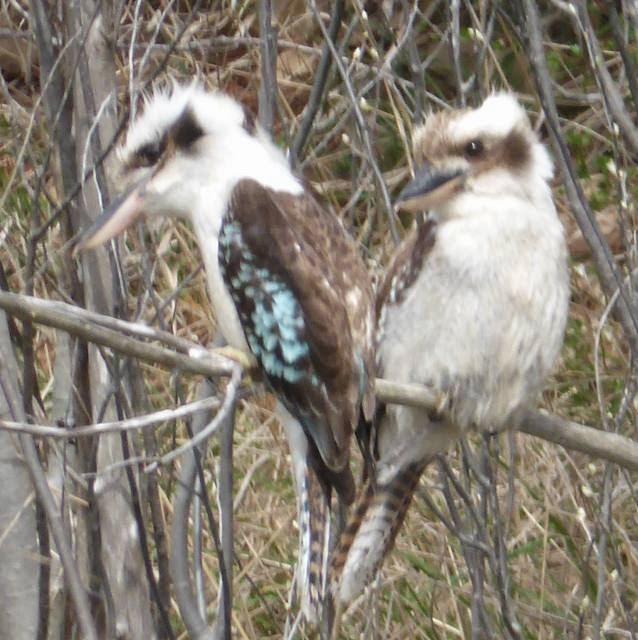
This pair of Laughing Kookaburras were sitting adjacent to the Fairy Martin culvert on Plains Rd.  I use the term 'pair' with caution as it implies they are more than 'good friends' and I don't know the sex of the one on the right.  The blue rump, just visible on the leftie, indicates adult male.

The migrants are continuing to return with the first Noisy Friarbird call (ruckus) being heard on the 2nd, the first Grey Fantail on the 3rd, and the first Leaden Flycatcher on the 26th.   Of the 12 migrant species which have returned so far 4 are early, 5 as expected and 3 are a tad late.  (The variation is typically +/- a single month.)

Two species have been added to the district list in the month.  A Whiskered Tern was seen (from the road) on Foxlow Lagoon  on 13 September.  A  Rose Robin passed through Whiskers Creek on the  23rd:  this has led me to compile a separate note on the various robins seen in the area.

In total we have recorded 95 species for the month.  A pleasant return towards the values of recent years and reflecting the return of some observers from distant climes.
Breeding is also happening with 8 species, indicated in red in the list below, recorded as undertaking some component of the reproductive process.  .  Our Tawny Frogmouths are now sitting on eggs.  I have been told of Black-fronted Dotterels having a nest with three eggs which seem to have hatched on 22 September, and Kookaburras nesting.  Striated pardalotes are using and investigating nesting sites.  

Thanks to observers in Wanna Wanna, the Molonglo Valley, Plains Rd and Widgiewa Rd for their contributions.

2 Birds of Prey:  Black-shouldered Kite; Brown Goshawk; Collared Sparrowhawk; Swamp Harrier; Wedge-tailed Eagle;  Nankeen Kestrel; Brown Falcon; Peregrine Falcon.


4 Kingfishers and other non-songbirds: Brown quail; Black‑eared Cuckoo; Shining Bronze‑cuckoo; Pallid Cuckoo; Fan‑tailed Cuckoo; Eastern Barn Owl; Tawny Frogmouth;  Laughing Kookaburra; Sacred Kingfisher; 

5 Honeyeaters: Eastern Spinebill; Yellow-faced Honeyeater; White-eared Honeyeater; Noisy Miner; Red Wattlebird;  Brown‑headed Honeyeater; White-naped Honeyeater; Noisy Friarbird

6 Flycatchers and similar species: Golden Whistler;Rufous Whistler; Grey Shrike-thrush; Grey Fantail; WillieWagtail; Leaden Flycatcher; Magpie-lark; Scarlet Robin; Rose Robin, Eastern Yellow Robin; Welcome Swallow; Fairy Martin; Tree Martin

7 Thornbills, Finches and similar species:  Superb Fairy-wren; White-browed Scrubwren; Chestnut-rumped heathwren; Speckled warbler; Weebill; Western Gerygone; White-throated Gerygone; Striated Thornbill; Yellow Thornbill; Yellow‑rumped Thornbill; Buff‑rumped Thornbill; Brown Thornbill; Southern Whiteface; Spotted Pardalote; Striated Pardalote; Silvereye; Zebra Finch; Double‑barred Finch; Red‑browed Finch; Diamond Firetail; House Sparrow; European Goldfinch

8 Other, smaller birds:  White-throated Treecreeper; Black-faced Cuckoo-shrike; Olive‑backed Oriole; Dusky Woodswallow; Skylark; Brown Songlark; Common Blackbird; Common Starling; Mistletoebird; Australasian  Pipit;

9  Other, larger birds: Satin Bowerbird; Grey Butcherbird; Australian Magpie; Pied Currawong; Grey Currawong; Australian Raven; Little Raven; White-winged Chough

August 2013

Update from last month: as a result of my trip away I omitted to include as a significant observation a report of Superb Lyrebird heard displaying in Cuumbeun Nature Reserve.

The exciting observation this month begin with a Nankeen Night-Heron seen in a garden in Clydesdale (thanks Terry and Ellie).
August is the month in which we can hope to see or hear the first returning migrants.  They are beginning with the first Pallid Cuckoo call coming on 20 August and being heard daily from then on, Yellow-faced Honeyeaters being seen from mid-month; the first Rufous Whistler on 29 Augusut; and several Dusky Woodswallows on the 31st.

Some breeding records are beginning to be reported as shown in the list below.  I am delighted that for the 6th year in a row the Tawny Frogmouths are building a nest at our place.  I have written a special post about the timing of breeding in our patch.

The number of species observed is again a good bit lower than last year (but does show the seasonal kick from the depths of July.
An analysis of (some of) the reasons for the decline is in a separate post.

Thanks to observers in Wanna Wanna Rd, Clydesdale, Captains Flat Rd, Widigiewa Rd and the Molonglo Valley for August reports. Please let me know if you see evidence of breeding, or other interesting birding sightings, by email to martinflab@gmail.com I'd stress that observations of what you think of as 'ordinary birds' because they are common on your patch can be very useful particularly when observers are few.

Breeding species are marked in red below and migrants are in italics.


2 Birds of Prey:  Brown Goshawk; Wedge-tailed Eagle; Brown Falcon;  Peregrine Falcon.

3 Parrots and Relatives:  Yellow-tailed Black-cockatoo;Gang‑gang Cockatoo; Galah;   Sulphur‑crested Cockatoo;  Crimson Rosella; Eastern Rosella; 
4 Kingfishers and other non-songbirds: ;Common Bronzewing; Crested Pigeon;  Tawny Frogmouth; Pallid Cuckoo; Laughing Kookaburra; 

5 Honeyeaters: Eastern Spinebill; Yellow-faced Honeyeater; White-eared Honeyeater; Noisy Miner; Red Wattlebird; New Holland Honeyeater;  Brown‑headed Honeyeater.

6 Flycatchers and similar species: Golden Whistler;Rufous Whistler; Grey Shrike-thrush;  WillieWagtail; Magpie-lark; Jacky Winter;Scarlet Robin;  Flame Robin; Eastern Yellow Robin; Welcome Swallow; Tree Martin

7 Thornbills, Finches and similar species:  Superb Fairy-wren; White-browed Scrubwren; Weebill; Striated Thornbill;  Yellow‑rumped Thornbill; Buff‑rumped Thornbill; Brown Thornbill; Spotted Pardalote; Striated Pardalote; Silvereye;  Red‑browed Finch; Diamond Firetail; House Sparrow; European Goldfinch

8 Other, smaller birds:  White-throated Treecreeper;Varied Sitella; Black-faced Cuckoo-shrike;  Dusky Woodswallow; Skylark; Common Blackbird; Common Starling; Mistletoebird; Australasian  Pipit;

9  Other, larger birds: Satin Bowerbird; Grey Butcherbird; Australian Magpie; Pied Currawong;Grey Currawong; Australian Raven; Little Raven; White-winged Chough

Why have all the birds gone?

The title is a little reminiscent of a famous Pete Seeger song, but unfortunately that doesn't supply any answers.  As far as I can tell none of the missing bird species have gone to young girls; husbands, the army or graveyards.

We have had a reduced number of observers in the lower parts of the area this year and this would certainly explain part of the 'problem'.  Here follow my other thoughts on the comparison of the  number of species observed in August 2012 and 2013.

2013
Yes No
2012 Yes 72 25
No 4 na

To deal with the four species 'added' in 2013 first, 1 is unusual (Nankeen Night-heron); the Pallid Cuckoo was an early return; and the Gang-gang and Silvereye are just chance.

More interest is in the (much larger number of) species seen in 2012 but not 2013.

Late arriving migrants
From comments in the COG bulletin 'Gang-gang' it seems that many migrants are delayed in their return to the Canberra Region, despite the warm winter.  For the purpose of this note I take that to be an explanation for 5 species: Fan-tailed Cuckoo; Grey fantail; Horsfield's Bronze-Cuckoo; Noisy friarbird; Shining Bronze-cuckoo.  Interestingly I first heard a Noisy Friarbird on 2 September, so they are only a little late.

Waterbirds
Apart from good rain in June and adequate rain in July, we have been through a relatively dry Autumn-Winter.  Although the dams and other wet areas aren't as dry as in 2009 there isn't a lot of water around.  (interestingly, an observer who has moved to Corryong comments that there is water everywhere down there).  5 species of waterbirds are MIA this year: Australasian Shoveler; Hoary-headed Grebe; Black Swan; Hardhead; Latham's Snipe.

Raptors
There was a surprising absence of reports of raptors in August 2013.  The Spotted Harriers which were regular over the swamp in the Plain have not been reported for a while; neither the relatively common Nankeen Kestrel nor Black-shouldered Kite have been seen; and the less frequently reported Little Eagle and Australian Hobby have been absent.  Perhaps the dry weather has decreased prey numbers?  Perhaps it is an outcome of reduced observer numbers on the Plain?

Quail
These birds are often hard to spot unless a lot of time is spent in the grassy areas.  This is an area where we have been lower on reports in August.  Neither of the local species (Brown Quail and Stubble Quail) were reported this month.  (This could also cover the Spotted Harrier; Latham's Snipe and Golden-headed Cistcola also found - like the rain in Spain - mainly on the Plain.)

Others
This leaves a group of 8 species.  Of these 2 (Red-rumped Parrot and Double-barred Finch) are usually easy to spot along the roads of the Plain but I haven't done so in August 2013.  The other 6 species are all relatively unusual in the area, and their absence is not remarkable.