Showing posts with label Ad-hoc reports. Show all posts

Saturday, May 5, 2018

Big Day Birding.

Big Day Birding

Each year eBird declares a Saturday as the Worldwide Big Day in which their members try to record as many species as possible.  I suspect the date is selected to be as close as possible to peak migration season in the USA, from where most eBird reports emanate.  However the most species on the day typically come from a country in South America (which isn't surprising as those countries typically have the greatest diversity).

In the past two years I have managed to get a couple of "world's biggest flocks".  In one year it was 150 Australian Magpies and the other a similar number of Little Ravens.  So I will be heading for the Plain later in the day.

By 6am AET there were 50 species reported with NZ leading the way with 21 species (again not surprising as it has been daylight there for about 2 hours, while still early evening of Friday in the Eastern US).  India, which can only just have got into the 5th, has 14 species, of which 7 are Owls or Nightjars.   Australia has 5 species - all nightbirds or species which make a ruckus at night such as Bush Stone Curlew.

I began my efforts with three checklists on our morning dog walk.  Between them they amounted to 17species (all pretty common).  When I checked the Big Day site at 0815 the sighting of 4 Yellow-rumped Thornbills was the first sighting of that species!  (That didn't last someone else submitted a sheet for an earlier time.)  However as at 14:25 my report of 36 Little Ravens was still holding up: that may not last as I have seen several flocks of over 100 in the past. (Still the record at 0547 on 6 May.  Not by 7 May: an observer scored 80 near Tullamarine Airport in Melbourne. )

Here is the track along Whiskers Creek Rd which we did once in each direction.  The reason for the little hook at the start is because I start at the edge of my Garden Bird Survey site.
Here is a view of Whiskers Creek Rd.  You may be able to pick out 2 'roos at the bottom of the slope!
 I recorded 10 species (best bird a Scarlet Robin) on the way out and 10 species on the way back, with as expected, a fair bit of overlap.  Best bird coming back was Grey Butcherbird.

This is the Widgiewa out and back.  Both directions on one list which was surprisingly short at 6 species.
It is always good to look down from the high point across the Plain  to the hills of Yanununbeyan to the South and the Great Dividing Range to the East.  Surprisingly the two 'roos here didn't get a verbal serve from Tammy.
After some more food and a couple of chores I took myself off to the Plain.  My first list was for a bit of Briars-Sharrow Rd and then the start of Plains Rd. 8 species along here with 39 Magpies and 36 Little Ravens.  However bird of the list was Eurasian Skylark, with 3 birds calling from various paddocks.
 A group of Crested Pigeons were obliging (both in posing and showing the bronze iridescence) ....
 .. as was this Laughing Kookaburra.
10 species were logged on the second half of Plains Rd.
 The most surprising bird was a White-faced Heron feeding in a pasture.  It wasn't so surprising to see Masked Lapwings in a similar position.
I then headed off to look down into Foxlow Lagoon.  Before I got there I noticed a Brown Falcon perched in a tree.  I thought the image looking into the sun was OK, and obviously the bird thought so too because it took off before I could get a more detailed view from the other direction.
 Further on down the road a flock of 25 Red Wattlebirds flew over, heading towards Tallaganda and the Coast,  On first looking at the Lagoon there didn't seem to be much around so I amused myself looking at the sheep chasing a trailer load of food around.

 This White-bellied Sea-Eagle wasn't too impressed with the 4x4 etc and took off.  A naff image but it proves the sighting!
 I have seen this species here several times and am faintly curious where they come from.  Possibly they are flying between Lake George and Googong Dam and see the Lagoon as the biggest water body between them?

Here is the state of the Lagoon.  Given the miserable amount of rain we have had in the last 5 months I am surprised there is still any water in it.
Looking closely you might see a cluster of waders beyond the mud bank.  This is a flock of 17 Red-necked Avocets which have been resident here for about 2 months.  Until this event I had only seen one Avocet in the Carwoola area.  Again naff image, taken on phone through telescope at 500m range.
 There were also 5 Black-winged Stilts which are more common in the area.  Good numbers (43 counted) of Pink-eared ducks which I presume were feeding on midge larvae, as reported a few months ago from the drying up dam on Lake Rd.  A Red-kneed Dotterel was just identifiable on the closest shore of the Lagoon.

Flame Robins were all over this site.  They were very mobile so difficult to count, but at one point I had 9 in one tree.  Here is a male ...
 .. and this a brown bird which could be a female or possibly an immature male.
 Back through Hoskinstown and head North on the road to Bungendore.
 Another Flame Robin was the highlight among the 6 species recorded. I was surprised that there was no activity in the Hawthorns although here they seemed to have shed their berries. I usually find a few species of duck on this dam, but not on the mini-desert  today.
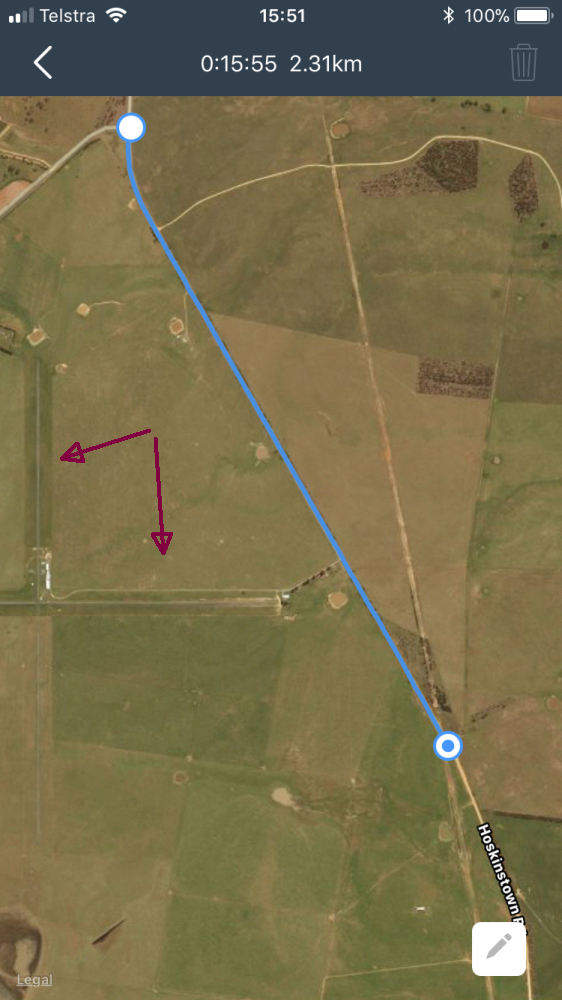
The second half of this stretch goes past the Mills Cross radio telescope - see arrows to two arms of the array.
 6 more Flame Robins and the only Willie Wagtail of the day  among 6 species.

The final list was 10 species recorded along Briars-Sharrow Road with a small clan of 4 White-winged Choughs seen at the Briars.
 Along here there were still lots of haws on the bushes but no Gang-gangs (nor even Starlings) feeding on them.
In total I recorded 48 species.

As at 0730 on 7 May 6,521 species had been recorded worldwide (cf 6332 last year) and 481 species in Australia.

Tuesday, March 6, 2018

What will be species 200?

Following the influx of new species in February 2018, giving  total of 198, I pondered what species will be #200 on our list.  There seem to be two broad classes of possibilities:

  1. species which have been recorded in the broad local area but which we haven't scored here; or
  2. a total vagrant not regularly seen in the ACT or anywhere close.

I don't think its possible to predict anything about class 1, but with class 2 there is some scope for contemplation.To get a handle on this I looked at my overall bird list (and I can't remember exactly how I acquired that - possibly a set of birds ever reported to COG including escapees, very old records and flat-out mis-identifications) of 290 species.  I then coded these fairly subjectively into 5 codes:

  1. Equivalent to group 1 above:
    1. Likely to be seen eventually (11 species)
    2. Unlikely but possible (6)
    3. Very unlikely but possible (13)
  2. Equivalent to group 2 above:
    1. Vagrants to ACT region (19)
    2. Where on earth did that come from? (41)
Logic says the next species or three should come from the 11 species in group 1.1.  They are:

  • White-headed Pigeon: Not common in Canberra but seems to be expanding its range especially along the coast in Victoria.
  • Peaceful Dove: Infrequent in the ACT mainly close to the Murrumbidgee.  Lack of water may hold it back from our area
  • Diamond Dove: as for Peaceful Dove.
  • Rainbow Lorikeet: Well established in parts of the ACT and a population in Queanbeyan.  I'd rate this as a definite contender.
  • Little Lorikeet: This was the second commonest Lorikeet in the ACT but no recent records.
  • Musk Lorikeet: Used to be quite uncommon but a near-resident population seems to have become established in Wanniassa,
  • Crested Shrike-tit: This species used to be common in restricted habitat in the ACT but seems to be less common recently.  I can't think of suitable habitat in this area.
  • Eastern Whipbird: Prefers moist forest - gullies in the Brindabellas are local stronghold.  Could find spots in Cuumbeun or Yanununbean
  • Pied Butcherbird: Becoming increasingly common (and now breeding) in the ACT.  It seems to be expanding its territory more than the Rainbow Lorikeet.  The question is will it been #199 or 200?
  • Little Wattlebird: Very common at the Coast and infrequent in Canberra.  I'm sure they come through the area, but no-one has yet spotted one!
  • Bassian Thrush: Reported from Tallaganda, ANBG and the Brindabella.  Could pop up here on the way between them.
Biting the bullet I'd say the next three species will be #199 Pied Butcherbird; #200 Rainbow Lorikeet and #201 White-headed Pigeon.

A roughy could come from the 6 species in Group 1.2:  Brush Bronzewing more densely wooded areas); Great Crested Grebe (Foxlow Lagoon, and the marsh on The Plain);  Caspian Tern (anywhere there is open water); Red-capped Plover (edges of any dam but uncommon in the area except Lakes George and Bathurst);  Little Egret (uncommon but anywhere there is water); and  White-bellied Cuckoo-shrike (uncommon, but could pop up anywhere).

Sunday, March 4, 2018

Migrant depatures

In my last monthly report I promised to look at migrant departures for 2018.  So here you are!

I have probably noted in the past that departures are a bit harder to deal with than arrivals.  This is not just a phenomenon of Carwoola or even Australia: Bill Oddie has noted in one of his tomes that spotting the last record for a year is a good way of getting your name in a birding clubs annual report.  It's not hard to see why:

  • when you see a bird for the first time in a year it is easy to know its the first time; but
  • if you see a bird on day x, late in the season; you don't know if you might also see one on day x+n (and 'n' might be quite a large number) so records have to be kept.
In the case of my records this means that not seeing a species in month X might mean they have migrated or just that no-one has reported one, and they might turn up next month.  So a definitive report can only be made at the end of the season.  However progress reports can be made about how the season is looking.

In this chart I have looked at the months in which migrant species have been spotted over the 11 years of this project and assessed which month is usually the last sighting.  This is marked in yellow in the graphic below.  I have then marked off whether the species has been seen or not in January or February and rated the status of the species.
I had noticed that cuckoos were very thin on the ground (or the tree or phone line) and that appears to be confirmed.  The only cuckoo recorded in February was a Horsfield's Bronze-Cuckoo.  The other 4 common Cuckoos had all vanished.  Possibly this is because the species they parasitise had given up nesting due to the dry January-mid February.

Overall, of the 12 species for which a rating is possible, 2 were seen after they would usually had gone, and 5 appear to have left early.  Arithmetic gives 5 species "on time" (so far). 

A further 9 species should get their status clarified in March.


Tuesday, January 16, 2018

Year to date in the yard

Apart from keeping records of birds seen in the area generally I also maintain a COG Garden Bird Survey site.  The principle of this is to record:

  1. the maximum number of birds of each species;
  2. seen in a week;
  3. within 100m of a house.
Practically the third criterion is a bit flexible since if a bird-attractive feature is nearby human nature will include the birds seen there.  So as long as the site is no larger than the area of a circle with radius 100m (ie 3.14 Ha) it is acceptable.  It is also helpful in maintaining some rigour if the boundaries are physically recognisable (eg fences, roads etc).  Birds overflying the site are included.

My site is shown below.
The polygon function of Google Earth shows the area as 2.8 Ha which is pretty close to the required limit.  Of course the area is not covered evenly: the section visible from my study window (see below) is monitored for 4 hours a day minimum while the dam and Whiskers Creek get checked for perhaps a couple of minutes every second day (depending on what I'm doing around the block).
The Survey operates on a year beginning 3 July so that breeding seasons falls within a single year.  It starts on 3rd July because the original proponents felt it important to keep the week numbers consistent with desk diaries (!!!! - but we are dealing with a Survey that starts before personal computers had been invented!) in which the the start of week 1 is January 1.

The reason for compiling this post is that the results for this GBS year so far are a bit strange in a number of ways. Since starting the site in February 2007 I have recorded 111 species within the site.  This chart shows the pattern through which that total has been arrived at.   
The dashed line is a logarithmic trend line which seems to be usual form of trend followed in such activities.  I added two species last GBS year:  Channel-billed Cuckoo (an unusual species in the Southern Tablelands) and Flame Robin (common on the Hoskinstown Plain but not up here - they are renowned colonisers after fire).  So far this year I have added one species: Rufous Songlark- again quite usual on the Plain but not so common up here.

One of the major unusual features of the year is the pattern of total diversity.  The next graph shows the cumulative total number of species seen as the current year progresses and the equivalent average over the 10 previous years..
We were seriously underperforming until the week ending 27 September, when 7 species were added to the tally.  The total got a further boost, of 6 species, in the first week of October.  Additional species have continued to be added.

I am currently at 81 species for the year.  I did an extrapolation of a trend line fitted to the data up to 16 January and that indicated about 85 species would be the total.  As there are 30 species seen in previous years which I have not yet recorded this year that seems to be quite achievable, and there are at least 10 MIAs which are regular in the Gazette area.

Another way of looking at the current year is that the number of species already recorded is equal to or greater than the number recorded in any full year except 2009-10.

Four species in particular had caught my attention as appearing more frequently than in the past.  To give a little rigour to the analysis I compiled a table of species seen by week compared this year (so far) with the average of other years.  This added a few more "interesting" species.

I have written a specific post about White-winged Triller so will not say more about them here.

The second species is Dusky Woodswallow.
So far this year I have recorded them in the GBS site in 19 weeks, whereas the average is 2.78 weeks per year.  In other years they have been very common on Whiskers Creek Road (about 300m away) but much less so this year.  They have also been very aggressive to other birds - including this Kookabura.
Note the hurtling Woodswallow  lower right in the photo.  (This image was rejected by ebird because the Kooburra dominated the depiction of the Woodswallow.)  They have also given Magpies similar treatment.  This made me wonder if they were nesting in the area and on 15 January I  saw a Dependent Young Woodswallow.

The third species is Red-rumped Parrot.  .
I had only recorded this species once before in the site, although they are very common on the (relatively) nearby Hoskinstown Plain.  This year I saw a flock of 4 fly over just after New Year's Day and since then have been seeing and hearing them almost daily.  It has been suggested that the bush fire has opened up the vegetation and allowed some plants attractive to the parrots to come to seed.

The fourth species is Tree Martin.  These are not widespread in the area but a remnant Brittle Gum Woodland - about 8km away - with lots of hollows is a common nesting site for the species.  This year I have recorded them in 6 weeks compared to an average of 3.2 weeks in other years.  Their call is distinctive and pretty much continual as they hawk overhead.

An addition thrown up by the quantitative analysis is Sacred Kingfisher.  I have recorded them in 7 weeks this year, which I thought "usual" but in fact I have only recorded them on average 2.3 weeks per year in the past.  They appeared to be trying to excavate a nest hollow at one point

but didn't pursue this endeavour.

I realised that only 29 weeks of the year had passed so then expanded the number of weeks seen by 52/29.  (This gave a few false positives for migrants as a much higher proportion of their period of presence has occurred, so I ignored them.)  The main additional species drawn to my attention by this step was Magpie Lark, which has been recorded 9 weeks (after adjustment 16 weeks) compared to an average of 6 weeks.

The analysis also drew my attention to some species which have dropped significantly in their reporting rate.  The two most obvious, before adjustment, were Eastern Yellow Robin (average 28 weeks and even after adjustment only 5 weeks) and White-eared Honeyeater (average 34 weeks. 3.5 weeks after adjustment).  The adjustment process also drew attention to reduced recording of Common Blackbird, Yellow-rumped Thornbill and Common Bronzewing.  For the last species, they are commonly attracted by the fallen seed of Acacia dealbata which shrubs largely got incinerated in the fires.  I have not yet come up with a theory about the reason for the disappearance of the other species.


Monday, January 15, 2018

White-winged Triller

The White-winged Triller is a Summer visitor to this area.  It is a boom or bust migrant, with many reports some years and few in other years.  The Summer of 2017-18 has been a boom year, at least as far as Carwoola is concerned with birds singing constantly since October.

The male and female are very different in appearance.  The male is yet another boldly black and white bird, with the white in the wings very obvious.
The female is  a basic brown bird.  I often have trouble identifying them and arrive at the ID only by ruling out all other possibilities (Pipits, Songlarks etc).
This year, more than any other I can recall, the birds have been very vocal around our block.  They have certainly lived up to the Triller name.

Getting down to the data, here are two graphs covering reporting rates for the whole COG area of interest.
The upper graph shows the birds arrive in October and stop being recorded in February.  I suspect that this may reflect in part them becoming quieter once breeding has been completed.  The lower chart reflects the boom or bust abundance of the species.  I suspect the very high peak in the late '80s is a boom year coinciding with extra observer effort around the Atlas of ACT birds.

The patterns are similar for our local observations.  First the monthly records, with a possible maximum of 11 years.
We have a couple of early records which is, I suspect, merely happenstance.  The fact that our recording rate jumps in November rather than October is yet another example of the impact of altitude.  We are about 200m higher than the main part of Canberra so seasonal effects tend to be a couple of weeks later here.

Now the annual data which is shown for a year ended June to avoid splitting the migration seasons.
It is unfortunate that the COG series ends in 2013 but where comparison is possible the pattern is broadly similar in the two series.

I wondered about the extent to which rainfall might explain (or at least correlate with) the variation in reporting rate in the local series.  That is shown here.
The correlation coefficient between the two series is -0.62 suggesting that the reporting rate is high when rainfall is low. 

As most the rainfall in a year ended June occurs after the birds have arrived here that is a tad hard to rationalise.  I wondered what the correlation was for the months July- September: the answer is -0.15, a much lower and insignificant value.  Could the rainfall in one year affect the reporting rate in the following year?  Nice try, no cigar - the correlation coefficient for that is -0.04, effectively zero!  Where I get to is some sort of theory that a long-term weather pattern sets up and leads to

  1. the Trillers coming here; and
  2. a dry period for several months.
If anyone wants to borrow that idea as the basis of a dissertation, feel free to do so.

Saturday, December 23, 2017

Noisy Friarbird nest

A few days ago I noticed that a Noisy Friarbird was frequently visiting a pin oak in our garden.  On applying my binoculars to one of its visits I realised that there was nest there.

Today I set up my telescope (with phone-camera adapter) on the spot and was very surprised to see up to 3 chicks poking their heads up.  My surprise arises because:
  • the nest has obviously been in operation for about 3 weeks and I hadn't noticed it; and
  • fencing contractors have been working  - including using a JCB backhoe - within 5 metres of the nest.
Here are a couple of photos.  The first just shows the nest.
 If you look closely at this one the head of a chick is just visible: the eye and the yellow gape are the things to look for.
I will try and get some clearer shots on a less windy day!

On Christmas day it was much cooler and in my checking of the nest I couldn't see any chicks. I was seriously hoping that a Currawong (Strepera graculina illegittima) hadn't raided the nest.  However on Boxing Day the adults were still coming to the nest and sticking their heads in.  Then an adult arrived and settled down to brood.


From about Boxing Day it became a bit tricky walking across the lawn as the adult birds practiced their swooping tactics.   More fencing work happened on the 27th and 28th and on the evening of the 28th I made it across the lawn without being swooped.  Had the adults abandoned the nest?  My next trip across the lawn gave a major swoop, so all is OK.  In addition, unlike the Pied Currawongs the Friarbirds aren't sexist: Frances also gets swooped.

Quite late in the evening of the 28th there was a large amount of Noisy Friarbird calling from the top of the Big Yellow Box.  At least 3 birds were up there calling and flying about in an agitated manner.  Eventually a brown Goshawk departed with the 3 Friarbirds in close formation behind it.

It isn't just raptors and humans that get chased: on the evening of the 30th December a pair of gang-gangs came into the garden and were immediately harassed by the friarbirds.  As Gang-gangs don't look like raptors, and don't fly like raptors, this must be some instinctive reaction to movement in the vicinity of the nest.

We walked across the lawn on 4 January and didn't get swooped!  A there had been more fencing going on we were unsure if this meant the chicks had fledged or if the parents had given up and abandoned.  Checking from a stepladder the nest was empty so a successful event!

Friday, October 6, 2017

Woodswallows and Trillers

An exciting visit of about 200 White-browed Woodswallows is covered in this post in my main blog.  Here is a taster snap.

Thursday, September 7, 2017

Start of Tawny Frogmouth nesting

I have been monitoring the breeding activities of a pair of Tawny Frogmouths since 2008 - a period of 10 years.  I have good measures of when nest building started for 7 of those years.  Of the other three years:
  • 2008 was the first year and I didn't realise the nest existed until I spotted the male in incubation mode;
  • 2011 the nest site moved to another tree, and again I didn't realise what was going on until the male went missing and I found him incubating.;
  • 2014 had - I now think - a false start, in that some twigs were blown into the nest site and gave a misleading picture.
For this year the birds seemed very late in starting their activities but on 6 September 2017, when we returned from Mallacoota, there were a few twigs in the nest fork.  On the morning of 7 September more twigs had arrived, but they hadn't yet been trampled ...
... so I am taking 6 September as the start of nest building.  (If they had started while we were away I think it would be no more than one day earlier.)  This is the latest date I have recorded: counting back from the date of fledging chicks 2008 may have been later but making assumptions like that is a very slippery slope.

This year has been pretty dry and - in terms of average minimum temperature - quite cold.  I wondered how these factors went in explaining the relatively late start on nest building.

I have daily data on rainfall, maximum and minimum temperatures for the period 2009 to the present.  I used this to build some data for analysis:
  • total rainfalls and average extreme temperatures for official Winter (June to August) and my version of Winter (July and August); and
  • number of days since 1 January to start of building
for each in-scope year.  On looking at the correlation coefficients it seemed that the 2 month weather data correlated more closely with the date of starting than the three month values so the shorter period data form this table (actually an image of a table)
The correlation coefficient for rainfall with date of starting building is quite strongly negative, suggesting that the lower the rainfall, the higher the number of days (ie the later the start of nesting).  The correlation for minimum temperature with date of starting is not so strong but again suggests a cold year gives later nesting.  The coefficient for maximum temperature is too weak to be considered.

The data can be plotted on a graph.
From my inexpert view this reinforces the idea that rainfall in July and August is the most important factor (of those I have assessed) in determining the start of nesting.

As the breeding event proceeds I shall look at other benchmarks (start of incubation and nest being empty).


Sunday, July 30, 2017

Breeding birds by month

The tables below are actually images as I can't (at this stage) work out how to save the table with the  columns shaded (which makes it a whole lot easier  to work out which month is what).

The numbers in each cell are the number of years (max = 11) in which the species has been recorded breeding.
The next image shows the situation for August 2017.