Tuesday, September 3, 2013

September 2013

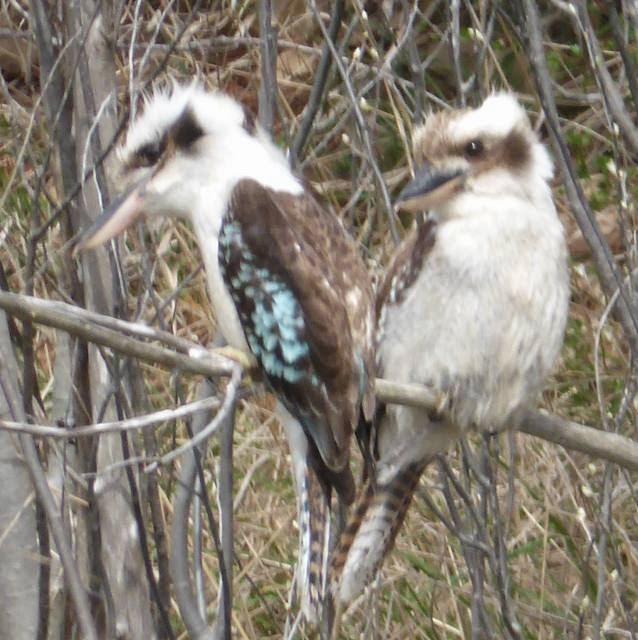
This pair of Laughing Kookaburras were sitting adjacent to the Fairy Martin culvert on Plains Rd.  I use the term 'pair' with caution as it implies they are more than 'good friends' and I don't know the sex of the one on the right.  The blue rump, just visible on the leftie, indicates adult male.

The migrants are continuing to return with the first Noisy Friarbird call (ruckus) being heard on the 2nd, the first Grey Fantail on the 3rd, and the first Leaden Flycatcher on the 26th.   Of the 12 migrant species which have returned so far 4 are early, 5 as expected and 3 are a tad late.  (The variation is typically +/- a single month.)

Two species have been added to the district list in the month.  A Whiskered Tern was seen (from the road) on Foxlow Lagoon  on 13 September.  A  Rose Robin passed through Whiskers Creek on the  23rd:  this has led me to compile a separate note on the various robins seen in the area.

In total we have recorded 95 species for the month.  A pleasant return towards the values of recent years and reflecting the return of some observers from distant climes.
Breeding is also happening with 8 species, indicated in red in the list below, recorded as undertaking some component of the reproductive process.  .  Our Tawny Frogmouths are now sitting on eggs.  I have been told of Black-fronted Dotterels having a nest with three eggs which seem to have hatched on 22 September, and Kookaburras nesting.  Striated pardalotes are using and investigating nesting sites.  

Thanks to observers in Wanna Wanna, the Molonglo Valley, Plains Rd and Widgiewa Rd for their contributions.

2 Birds of Prey:  Black-shouldered Kite; Brown Goshawk; Collared Sparrowhawk; Swamp Harrier; Wedge-tailed Eagle;  Nankeen Kestrel; Brown Falcon; Peregrine Falcon.


4 Kingfishers and other non-songbirds: Brown quail; Black‑eared Cuckoo; Shining Bronze‑cuckoo; Pallid Cuckoo; Fan‑tailed Cuckoo; Eastern Barn Owl; Tawny Frogmouth;  Laughing Kookaburra; Sacred Kingfisher; 

5 Honeyeaters: Eastern Spinebill; Yellow-faced Honeyeater; White-eared Honeyeater; Noisy Miner; Red Wattlebird;  Brown‑headed Honeyeater; White-naped Honeyeater; Noisy Friarbird

6 Flycatchers and similar species: Golden Whistler;Rufous Whistler; Grey Shrike-thrush; Grey Fantail; WillieWagtail; Leaden Flycatcher; Magpie-lark; Scarlet Robin; Rose Robin, Eastern Yellow Robin; Welcome Swallow; Fairy Martin; Tree Martin

7 Thornbills, Finches and similar species:  Superb Fairy-wren; White-browed Scrubwren; Chestnut-rumped heathwren; Speckled warbler; Weebill; Western Gerygone; White-throated Gerygone; Striated Thornbill; Yellow Thornbill; Yellow‑rumped Thornbill; Buff‑rumped Thornbill; Brown Thornbill; Southern Whiteface; Spotted Pardalote; Striated Pardalote; Silvereye; Zebra Finch; Double‑barred Finch; Red‑browed Finch; Diamond Firetail; House Sparrow; European Goldfinch

8 Other, smaller birds:  White-throated Treecreeper; Black-faced Cuckoo-shrike; Olive‑backed Oriole; Dusky Woodswallow; Skylark; Brown Songlark; Common Blackbird; Common Starling; Mistletoebird; Australasian  Pipit;

9  Other, larger birds: Satin Bowerbird; Grey Butcherbird; Australian Magpie; Pied Currawong; Grey Currawong; Australian Raven; Little Raven; White-winged Chough

August 2013

Update from last month: as a result of my trip away I omitted to include as a significant observation a report of Superb Lyrebird heard displaying in Cuumbeun Nature Reserve.

The exciting observation this month begin with a Nankeen Night-Heron seen in a garden in Clydesdale (thanks Terry and Ellie).
August is the month in which we can hope to see or hear the first returning migrants.  They are beginning with the first Pallid Cuckoo call coming on 20 August and being heard daily from then on, Yellow-faced Honeyeaters being seen from mid-month; the first Rufous Whistler on 29 Augusut; and several Dusky Woodswallows on the 31st.

Some breeding records are beginning to be reported as shown in the list below.  I am delighted that for the 6th year in a row the Tawny Frogmouths are building a nest at our place.  I have written a special post about the timing of breeding in our patch.

The number of species observed is again a good bit lower than last year (but does show the seasonal kick from the depths of July.
An analysis of (some of) the reasons for the decline is in a separate post.

Thanks to observers in Wanna Wanna Rd, Clydesdale, Captains Flat Rd, Widigiewa Rd and the Molonglo Valley for August reports. Please let me know if you see evidence of breeding, or other interesting birding sightings, by email to martinflab@gmail.com I'd stress that observations of what you think of as 'ordinary birds' because they are common on your patch can be very useful particularly when observers are few.

Breeding species are marked in red below and migrants are in italics.


2 Birds of Prey:  Brown Goshawk; Wedge-tailed Eagle; Brown Falcon;  Peregrine Falcon.

3 Parrots and Relatives:  Yellow-tailed Black-cockatoo;Gang‑gang Cockatoo; Galah;   Sulphur‑crested Cockatoo;  Crimson Rosella; Eastern Rosella; 
4 Kingfishers and other non-songbirds: ;Common Bronzewing; Crested Pigeon;  Tawny Frogmouth; Pallid Cuckoo; Laughing Kookaburra; 

5 Honeyeaters: Eastern Spinebill; Yellow-faced Honeyeater; White-eared Honeyeater; Noisy Miner; Red Wattlebird; New Holland Honeyeater;  Brown‑headed Honeyeater.

6 Flycatchers and similar species: Golden Whistler;Rufous Whistler; Grey Shrike-thrush;  WillieWagtail; Magpie-lark; Jacky Winter;Scarlet Robin;  Flame Robin; Eastern Yellow Robin; Welcome Swallow; Tree Martin

7 Thornbills, Finches and similar species:  Superb Fairy-wren; White-browed Scrubwren; Weebill; Striated Thornbill;  Yellow‑rumped Thornbill; Buff‑rumped Thornbill; Brown Thornbill; Spotted Pardalote; Striated Pardalote; Silvereye;  Red‑browed Finch; Diamond Firetail; House Sparrow; European Goldfinch

8 Other, smaller birds:  White-throated Treecreeper;Varied Sitella; Black-faced Cuckoo-shrike;  Dusky Woodswallow; Skylark; Common Blackbird; Common Starling; Mistletoebird; Australasian  Pipit;

9  Other, larger birds: Satin Bowerbird; Grey Butcherbird; Australian Magpie; Pied Currawong;Grey Currawong; Australian Raven; Little Raven; White-winged Chough

Why have all the birds gone?

The title is a little reminiscent of a famous Pete Seeger song, but unfortunately that doesn't supply any answers.  As far as I can tell none of the missing bird species have gone to young girls; husbands, the army or graveyards.

We have had a reduced number of observers in the lower parts of the area this year and this would certainly explain part of the 'problem'.  Here follow my other thoughts on the comparison of the  number of species observed in August 2012 and 2013.

2013
Yes No
2012 Yes 72 25
No 4 na

To deal with the four species 'added' in 2013 first, 1 is unusual (Nankeen Night-heron); the Pallid Cuckoo was an early return; and the Gang-gang and Silvereye are just chance.

More interest is in the (much larger number of) species seen in 2012 but not 2013.

Late arriving migrants
From comments in the COG bulletin 'Gang-gang' it seems that many migrants are delayed in their return to the Canberra Region, despite the warm winter.  For the purpose of this note I take that to be an explanation for 5 species: Fan-tailed Cuckoo; Grey fantail; Horsfield's Bronze-Cuckoo; Noisy friarbird; Shining Bronze-cuckoo.  Interestingly I first heard a Noisy Friarbird on 2 September, so they are only a little late.

Waterbirds
Apart from good rain in June and adequate rain in July, we have been through a relatively dry Autumn-Winter.  Although the dams and other wet areas aren't as dry as in 2009 there isn't a lot of water around.  (interestingly, an observer who has moved to Corryong comments that there is water everywhere down there).  5 species of waterbirds are MIA this year: Australasian Shoveler; Hoary-headed Grebe; Black Swan; Hardhead; Latham's Snipe.

Raptors
There was a surprising absence of reports of raptors in August 2013.  The Spotted Harriers which were regular over the swamp in the Plain have not been reported for a while; neither the relatively common Nankeen Kestrel nor Black-shouldered Kite have been seen; and the less frequently reported Little Eagle and Australian Hobby have been absent.  Perhaps the dry weather has decreased prey numbers?  Perhaps it is an outcome of reduced observer numbers on the Plain?

Quail
These birds are often hard to spot unless a lot of time is spent in the grassy areas.  This is an area where we have been lower on reports in August.  Neither of the local species (Brown Quail and Stubble Quail) were reported this month.  (This could also cover the Spotted Harrier; Latham's Snipe and Golden-headed Cistcola also found - like the rain in Spain - mainly on the Plain.)

Others
This leaves a group of 8 species.  Of these 2 (Red-rumped Parrot and Double-barred Finch) are usually easy to spot along the roads of the Plain but I haven't done so in August 2013.  The other 6 species are all relatively unusual in the area, and their absence is not remarkable.

Friday, August 23, 2013

Breeding Birds

As we are approaching the time when birds start to think about continuing their species I thought I would take a look at what the existing records tell  us about the timing of breeding in Carwoola.

I have got 428 Breeding records (widely defined: see below) of which 349 have been coded to month and type of event.  I have compacted the type of event into 3 categories
  1. Pre-nesting: display, copulation, inspecting hollow and nest building (59 records)
  2. Nesting: Nest with eggs; nest with young, on nest, carrying food (116 records)
  3. Dependent young. (174 records).

The distribution of these broad groups through the year is illustrated below.
This does to a large extent follow common sense: pre-nesting activities peak first (August- September), then the nesting phase (October - November) and then dependent young in December January.  The dependent young recorded after February may be second broods (or more likely what I refer to as indolent young: capable of looking after themselves but prefer to bludge off the olds - this term is not recognised by the birding hierarchy).

Tuesday, August 20, 2013

Its migrant time!

I have posted a few warbles about migrants in the past.  The most important (OK, less trivial) of these was a consideration of which species were "practical" Summer migrants to the Carwoola area.  I have used that term to exclude species listed by COG as migrants but which
  • Migrate to Carwoola in Winter; or
  • Regularly occur in this area year round; or
  • Occur very rarely in this area.
There are 20 of these practical migrant species, and given that I have record for 7 years (months February to July) or 6 years (August to January - we moved her in February 2007) the maximum number of species-years per month is 140 or 120.  In practise the maximum score is only 97 (in November) as some species are somewhat unusual.
The species with the lowest number of records are:

  • Rufous Songlark (12 records) arrives late and is only reported for three months.  This possibly reflects it only being 'noticed' when the males do a display flight.
  • Dollarbird (13 records) A rather more noticeable species, but it seems absent away from the Hoskinstown area.
  • White-winged triller: (13 records)  This species almost disappeared from the Canberra area during the wet years.  In drier periods could be expected for about 6 months.
  • White-throated Needletail:  (15 records) Only likely in 3 months (Jan to March) although we have had 2 December records.
  • Brush Cuckoo: later arriving, and earlier leaving that the other common local cuckoos.  That is interesting as I have found it quite regualarly in the Tinderries up to 1200m.

This next image shows the number of years in which each of the species were seen each month (click on the image to make it legible).
The species likely to return in August are Horsefields Bronze-Cuckoo, Pallid Cuckoo (already heard, 20/8), Fan-tailed Cuckoo, Olive-backed Oriole, Dusky Woodswallow, and Tree Martin.

Tuesday, July 16, 2013

July 2013

If you typed in the address from the Gazette you will have ended up on this page,  This link takes you to the August Report.

This month has been a bit thin on the ground.   Only 63 species were reported in the month of July, the first time we have been below 70 species for 5 years.

To some extent this reflects the absence of observers - even I was away for the second half of the month.  However, a report to COG has also noted the paucity of birds in July.

The most interesting sighting in our area was two White-bellied Sea-Eagles flying over the Hoskinstown Plain, from the direction of the village heading Northwards. There have been 2 reports of Peregrine Falcons.  One from Widgiewa Rd (in hot pursuit of some unidentified prey) and the Hoskinstown Plain (looking for a straggler from a flock of 100+ Galahs)  Other notable sightings include a Barn Owl (heard on the Hoskinstown Plain early in the month; a flock of 120+ Yellow-tailed Black-Cockatoos flying from Whiskers Creek towards the Taliesin Hills; and an amazing number (at least 15) of Flame Robins feeding along a fence line on the Plain.

Thanks to observers in Widgiewa Rd, and the Hoskinstown Plain for reports.

In Canberra the early breeders are already building their nests so readers should keep their eyes open for such activities.  Certainly the Skylarks are making a lot of song on the Plain and I am expecting 'our' pair of Tawny Frogmouths to start building their nest any time from now.

Please let me know if you see evidence of breeding, or other interesting birding sightings, by email to martinflab@gmail.com.  I'd stress that observations of what you think of as 'ordinary birds' because they are common on your patch can be very useful particularly when observers are few - there are several common species that were not reported this month.

Species seen this month.


2 Birds of Prey:  White-bellied Sea-eagle;Wedge-tailed Eagle; Little Eagle; Nankeen Kestrel;Brown Falcon;  Peregrine Falcon.

4 Kingfishers and other non-songbirds:  Crested Pigeon; Tawny Frogmouth; Eastern Barn Owl; Laughing Kookaburra

5 Honeyeaters: Eastern Spinebill;  White-eared Honeyeater; Noisy Miner; Red Wattlebird; New Holland Honeyeater.

6 Flycatchers and similar species: Golden Whistler; Grey Shrike-thrush;  WillieWagtail;  Magpie-lark; Scarlet Robin;  Flame Robin; Eastern Yellow Robin; Welcome Swallow.

7 Thornbills, Finches and similar species:  Superb Fairy-wren; White-browed Scrubwren; Weebill; Striated Thornbill; Yellow‑rumped Thornbill; Buff‑rumped Thornbill;  Double‑barred Finch; Red‑browed Finch; Diamond Firetail; House Sparrow; European Goldfinch

8 Other, smaller birds:  White-throated Treecreeper;  Skylark; Golden-headed Cisticola; Common Blackbird; Common Starling; Australasian  Pipit;

9  Other, larger birds:  Grey Butcherbird; Australian Magpie; Pied Currawong;Grey Currawong; Australian Raven; Little Raven; White-winged Chough


Sunday, June 30, 2013

June 2013

I'll start this month by thanking John Bisset of Widgiewa Rd for his contribution to these records over the past several years.  He has now moved to Victoria and will be missed.

The most exciting sighting was a White-bellied Sea Eagle lifting off from a kangaroo on Wanna‑wanna Rd.  It was subsequently seen at another nearby property.

Late one evening I heard what I interpreted as a "mad-woman scream” call (or possibly two birds doing so).  This is usually associated with Barking Owls, but on listening to my collection of bird calls, the best match was Eastern Barn Owl.  They seem to be back in the area.  It is possibly not a coincidence that mice also seem to have returned!

Finally, on a stroll around a property on the HoskinstownPlain a flock of 7 Flame Robins – 3 of them males in full glory – were seen.  I have also seen good numbers of them along the road to Foxlow Bridge.   As the birds are rated as threatened in NSW it is good that our area supports quite a few of them.

As is usually the case June has shown a drop (4 species) , compared to May, in the number of species seen in the area.  This year that is probably influenced by weather which is not conducive to birding but mainly by the absence - in some cases permanent - of some regular contributors.  Thank you to those who have stepped up more than usually, to report their sightings (which are of course always welcome).

In total we have recorded 78 species for the month, 1 down on last June but adequately up on the four year average of 74.75. 
Thanks to contributors in Wanna Wanna,  Radcliffe, Widgeiewa Rd and Hoskinstown for their reports


1  Waterbirds:  Australian Wood Duck; Grey Teal;  Pacific Black Duck; Hardhead;Australasian Grebe; Hoary-headed Grebe; Little Pied Cormorant; White‑faced Heron;  Glossy Ibis; Australian White Ibis; Straw-necked Ibis;  Eurasian Coot; Masked Lapwing; Banded Lapwing
2 Birds of Prey:  Black-shouldered Kite; White-bellied Sea-eagle; Brown Goshawk; Wedge-tailed Eagle; Nankeen Kestrel; Brown Falcon
 4 Kingfishers and other non-songbirds: Stubble Quail; Common Bronzewing; Crested Pigeon; Tawny Frogmouth; Australian Owlet-nightjar;  Eastern Barn Owl; Laughing Kookaburra
5 Honeyeaters: Eastern Spinebill; Yellow-faced Honeyeater; White-eared Honeyeater; Noisy Miner; Red Wattlebird; New Holland Honeyeater; Brown‑headed Honeyeater
6 Flycatchers and similar species: Golden Whistler; Grey Shrike-thrush; Grey Fantail; WillieWagtail; Magpie-lark; Scarlet Robin; Flame Robin; Welcome Swallow
7 Thornbills, Finches and similar species:  Superb Fairy-wren; White-browed Scrubwren; Weebill; Striated Thornbill; Yellow‑rumped Thornbill; Buff‑rumped Thornbill; Brown Thornbill; Spotted Pardalote; Striated Pardalote; Silvereye; Double‑barred Finch; Red‑browed Finch; Diamond Firetail; House Sparrow; European Goldfinch
8 Other, smaller birds:  White-throated Treecreeper; Golden-headed Cisticola; Common Blackbird; Common Starling; Mistletoebird; Australasian  Pipit;
9  Other, larger birds: Satin Bowerbird; Grey Butcherbird; Australian Magpie; Pied Currawong;Grey Currawong; Australian Raven; Little Raven; White-winged Chough

I have also put some birdbath images on my home blog.

I try to avoid promoting commercial thingies on my blogs but some of you may not have heard of the latest book by Ian Fraser (with Jeannie Gray) on Australian Bird Names.  It explains how the names arose and what they mean (both common names and the Latin).  A good read!