Wednesday, May 30, 2018

May 2018

An observer sent me this image of a juvenile Brown Goshawk which killed a mouse beside their back door.
It is a very appropriate image to kick off with as one of the highlights of the month has been the number of raptor species, with 9 species reported. As shown in this chart that is well above average for any month
The most exciting was a Black Falcon* seen on the Plain near Briars Sharrow Rd.  This our 9th record, with 6 of those coming from 2011-12.   As this observation follows a sighting in Bungendore a few weeks earlier a bird may have taken up residence in the broad area.

Overall we recorded 86 species, the most ever recorded in May.  As several of the regular reporters (including the author) spent a fair proportion of the month elsewhere that is a very good outcome.
Other less common birds include Pink-eared Ducks and the continuing flock of Red-necked Avocets and Pied Stilts (formerly known as Black-winged Stilts) and continued reports of Banded Lapwings from the Plain.  An unusual sighting, in terms of the number of birds, was a flock of 12-15 Gang-gangs overflying Walga Close although I have also received a report of a regular flock close to that size on Radcliffe.  (That site is also being visited by King Parrots, "feeding on left-over tomatoes". )

Little action this month on migrants and no breeding activity.

As always, thanks to the observers who have provided reports to me for the month.  These have covered sites in Whiskers Creek Rd, Widgiewa Rd, Wanna Wanna Rd, Radcliffe, Walga Close, Captains Flat Rd;  and Hoskinstown Village and Plain.  Readers might also be interested in this post about a (modest) Big Day on 5 May.  Comments welcome to martinflab@gmail.com.

1  Waterbirds (pt 1):  (pt 2); (Pt 3); (Pt 4):  Black Swan; Australian Wood Duck; Pink-eared Duck; Grey Teal; Pacific Black Duck; Hardhead; Australasian Grebe; Hoary-headed Grebe; Little Black Cormorant; Little Pied Cormorant; Great Cormorant; White-necked Heron; White‑faced Heron;  Eurasian  Coot; Black-winged Stilt; Red-necked Avocet; Red-kneed Dotterel; Masked Lapwing; Banded Lapwing; 

2 Birds of Prey:  Black-shouldered Kite; White-bellied Sea-eagle; Whistling Kite, Brown Goshawk; Collared Sparrowhawk; Wedge-tailed Eagle; Nankeen Kestrel; Brown Falcon; Black Falcon, 

3 Parrots and Relatives:   Yellow-tailed Black-Cockatoo; Gang‑gang Cockatoo; Galah;  Sulphur‑crested Cockatoo; Australian King‑parrot;  Crimson Rosella; Eastern Rosella; Hybrid Crimson-Eastern Rosella; Red-rumped Parrot

4 Kingfishers and other non-songbirds (Pt 1) (Pt 2) (Pt 3):  Common Bronzewing; Crested Pigeon; Tawny Frogmouth; Australian Owlet-nightjar; Laughing Kookaburra; 

5 Honeyeaters: Eastern Spinebill; Yellow-faced Honeyeater; White-eared Honeyeater;  Noisy Miner; Red Wattlebird; , Brown‑headed Honeyeater; White-naped Honeyeater; 

6 Flycatchers and similar species: Golden Whistler;Rufous Whistler; Grey Shrike-thrush; Grey Fantail; Willie Wagtail; Magpie-lark; Scarlet Robin; Red‑capped Robin, Flame Robin;  Welcome Swallow;

7 Thornbills, Finches and similar species (Pt 1) (Pt 2):  Superb Fairy-wren; White-browed Scrubwren;  Weebill; ; Striated Thornbill; Yellow‑rumped Thornbill; Buff‑rumped Thornbill; Brown Thornbill; Spotted Pardalote; Striated Pardalote; Silvereye; Red‑browed Finch; Diamond Firetail; House Sparrow;

8 Other, smaller birds:  White-throated Treecreeper; Skylark;  Common Blackbird; Common Myna; Common Starling; Mistletoebird; Australasian  Pipit;

9  Other, larger birds: Satin Bowerbird; Grey Butcherbird; Australian Magpie; Pied Currawong; Grey Currawong; Australian Raven; Little Raven; White-winged Chough

* Yes, I am convinced it wasn't a dark grey Commodore.

Saturday, May 5, 2018

Big Day Birding.

Big Day Birding

Each year eBird declares a Saturday as the Worldwide Big Day in which their members try to record as many species as possible.  I suspect the date is selected to be as close as possible to peak migration season in the USA, from where most eBird reports emanate.  However the most species on the day typically come from a country in South America (which isn't surprising as those countries typically have the greatest diversity).

In the past two years I have managed to get a couple of "world's biggest flocks".  In one year it was 150 Australian Magpies and the other a similar number of Little Ravens.  So I will be heading for the Plain later in the day.

By 6am AET there were 50 species reported with NZ leading the way with 21 species (again not surprising as it has been daylight there for about 2 hours, while still early evening of Friday in the Eastern US).  India, which can only just have got into the 5th, has 14 species, of which 7 are Owls or Nightjars.   Australia has 5 species - all nightbirds or species which make a ruckus at night such as Bush Stone Curlew.

I began my efforts with three checklists on our morning dog walk.  Between them they amounted to 17species (all pretty common).  When I checked the Big Day site at 0815 the sighting of 4 Yellow-rumped Thornbills was the first sighting of that species!  (That didn't last someone else submitted a sheet for an earlier time.)  However as at 14:25 my report of 36 Little Ravens was still holding up: that may not last as I have seen several flocks of over 100 in the past. (Still the record at 0547 on 6 May.  Not by 7 May: an observer scored 80 near Tullamarine Airport in Melbourne. )

Here is the track along Whiskers Creek Rd which we did once in each direction.  The reason for the little hook at the start is because I start at the edge of my Garden Bird Survey site.
Here is a view of Whiskers Creek Rd.  You may be able to pick out 2 'roos at the bottom of the slope!
 I recorded 10 species (best bird a Scarlet Robin) on the way out and 10 species on the way back, with as expected, a fair bit of overlap.  Best bird coming back was Grey Butcherbird.

This is the Widgiewa out and back.  Both directions on one list which was surprisingly short at 6 species.
It is always good to look down from the high point across the Plain  to the hills of Yanununbeyan to the South and the Great Dividing Range to the East.  Surprisingly the two 'roos here didn't get a verbal serve from Tammy.
After some more food and a couple of chores I took myself off to the Plain.  My first list was for a bit of Briars-Sharrow Rd and then the start of Plains Rd. 8 species along here with 39 Magpies and 36 Little Ravens.  However bird of the list was Eurasian Skylark, with 3 birds calling from various paddocks.
 A group of Crested Pigeons were obliging (both in posing and showing the bronze iridescence) ....
 .. as was this Laughing Kookaburra.
10 species were logged on the second half of Plains Rd.
 The most surprising bird was a White-faced Heron feeding in a pasture.  It wasn't so surprising to see Masked Lapwings in a similar position.
I then headed off to look down into Foxlow Lagoon.  Before I got there I noticed a Brown Falcon perched in a tree.  I thought the image looking into the sun was OK, and obviously the bird thought so too because it took off before I could get a more detailed view from the other direction.
 Further on down the road a flock of 25 Red Wattlebirds flew over, heading towards Tallaganda and the Coast,  On first looking at the Lagoon there didn't seem to be much around so I amused myself looking at the sheep chasing a trailer load of food around.

 This White-bellied Sea-Eagle wasn't too impressed with the 4x4 etc and took off.  A naff image but it proves the sighting!
 I have seen this species here several times and am faintly curious where they come from.  Possibly they are flying between Lake George and Googong Dam and see the Lagoon as the biggest water body between them?

Here is the state of the Lagoon.  Given the miserable amount of rain we have had in the last 5 months I am surprised there is still any water in it.
Looking closely you might see a cluster of waders beyond the mud bank.  This is a flock of 17 Red-necked Avocets which have been resident here for about 2 months.  Until this event I had only seen one Avocet in the Carwoola area.  Again naff image, taken on phone through telescope at 500m range.
 There were also 5 Black-winged Stilts which are more common in the area.  Good numbers (43 counted) of Pink-eared ducks which I presume were feeding on midge larvae, as reported a few months ago from the drying up dam on Lake Rd.  A Red-kneed Dotterel was just identifiable on the closest shore of the Lagoon.

Flame Robins were all over this site.  They were very mobile so difficult to count, but at one point I had 9 in one tree.  Here is a male ...
 .. and this a brown bird which could be a female or possibly an immature male.
 Back through Hoskinstown and head North on the road to Bungendore.
 Another Flame Robin was the highlight among the 6 species recorded. I was surprised that there was no activity in the Hawthorns although here they seemed to have shed their berries. I usually find a few species of duck on this dam, but not on the mini-desert  today.
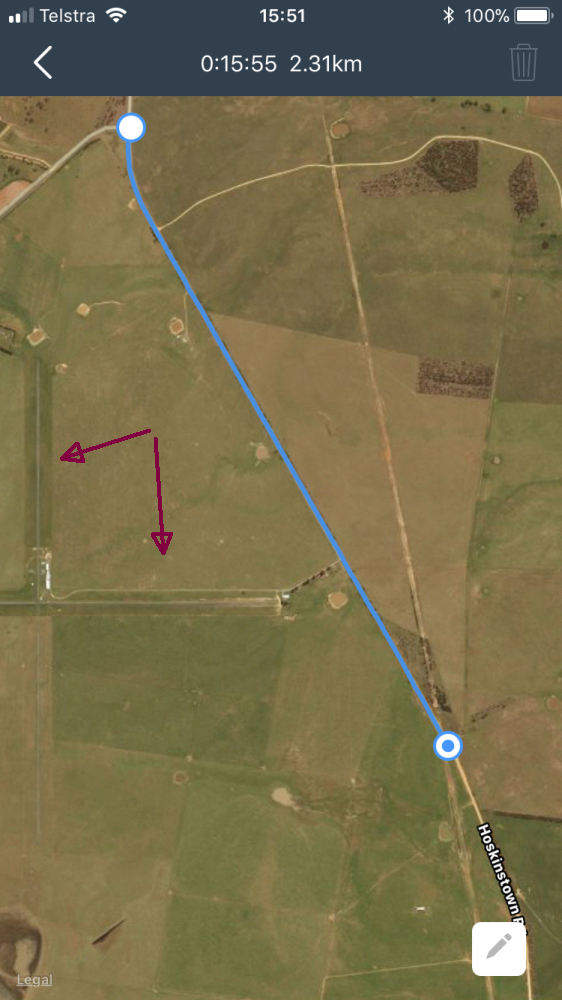
The second half of this stretch goes past the Mills Cross radio telescope - see arrows to two arms of the array.
 6 more Flame Robins and the only Willie Wagtail of the day  among 6 species.

The final list was 10 species recorded along Briars-Sharrow Road with a small clan of 4 White-winged Choughs seen at the Briars.
 Along here there were still lots of haws on the bushes but no Gang-gangs (nor even Starlings) feeding on them.
In total I recorded 48 species.

As at 0730 on 7 May 6,521 species had been recorded worldwide (cf 6332 last year) and 481 species in Australia.

Wednesday, April 25, 2018

April 2018

The weather for April was rather warm and desperately dry.  Despite that, the birds were rather 'normal'.

For less common birds a Royal Spoonbill was seen at Foxlow Lagoon and a Rose Robin at a birdbath in Walga Close.  A visit to the billabong in the community land at the end of Molonglo River Park also delivered Australian Swamphen and Dusky Moorhen, neither of which are common in this area.

Powerful Owls are still being heard on Wanna Wanna Rd, and a pair has also been heard in Wamboin (surely different birds).  Perhaps the "controlled" burns in the bush are driving this species into more settled areas?

A good sighting, of a species viewed with some concern in the ACT, was a flock of 20+ Gang-gangs doing laps over the Molonglo.  At this time of year they often appear in larger flocks, like this, feeding on the hawthorns on the Plain.

Overall we recorded 96 species this month.
This is shown as well above average which surprised me a little.  It appears that the average is depressed by low numbers seen in April 2014: a cool and wet month.

Being in Autumn there is no breeding activity but outwards migration is in full swing, with flocks of Yellow-faced Honeyeaters (maximum ~80 birds) coming over Whiskers Creek Rd more or less constantly.  As expected some White-naped Honeyeaters were also in the flocks: some dropped into our bird bath for a drink.

The few species which return to the area for Winter have also appeared.  Golden Whistlers have replaced Rufous Whistlers  and Flame Robins have been reported.

As always, thanks to the observers who have provided reports to me for the month.  These have covered sites in Whiskers Creek Rd, Walga Close, Molonglo Valley, Widgiewa Rd, Wanna Wanna Rd, and Hoskinstown Village and Plain.  A member of COG also visited our area and provided a helpful list.  

Please pass on interesting sightings to me by email to martinflab@gmail.com. 


1  Waterbirds (pt 1):  (pt 2); (Pt 3); (Pt 4): Black Swan;  Australian Shelduck; Australian Wood Duck; Australian Shoveler; Grey Teal; Chestnut Teal; Pacific Black Duck; Australasian Grebe; Hoary-headed Grebe; Little Black Cormorant; Little Pied Cormorant; White‑faced Heron; Australian White Ibis; Straw-necked Ibis; Royal Spoonbill; Purple Swamphen; Dusky Moorhen;  Eurasian  Coot; Black-winged Stilt; Red-necked Avocet; Red-kneed Dotterel; Masked Lapwing; Banded Lapwing.

2 Birds of Prey:  Black-shouldered Kite; Brown Goshawk; Wedge-tailed Eagle; Nankeen Kestrel; Brown Falcon.

3 Parrots and Relatives:  Yellow-tailed Black-Cockatoo; Gang‑gang Cockatoo; Galah;  Sulphur‑crested Cockatoo; Australian King‑parrot; Crimson Rosella; Eastern Rosella; Red-rumped Parrot

4 Kingfishers and other non-songbirds (Pt 1) (Pt 2) (Pt 3):Rock Dove; Common Bronzewing; Crested Pigeon; Tawny Frogmouth; Powerful Owl; Laughing Kookaburra.

5 Honeyeaters: Eastern Spinebill; Yellow-faced Honeyeater; White-eared Honeyeater;  Noisy Miner; Red Wattlebird; Brown‑headed Honeyeater; White-naped Honeyeater; Noisy Friarbird; 

6 Flycatchers and similar species: Golden Whistler;Rufous Whistler; Grey Shrike-thrush;  Grey Fantail; Willie Wagtail; Leaden Flycatcher; Magpie-lark; Scarlet Robin; Red‑capped Robin, Flame Robin; Rose Robin,  Eastern Yellow Robin; Welcome Swallow;

7 Thornbills, Finches and similar species (Pt 1) (Pt 2):  Superb Fairy-wren; White-browed Scrubwren; Weebill;  White-throated Gerygone; Striated Thornbill; Yellow‑rumped Thornbill; Buff‑rumped Thornbill; Brown Thornbill; Southern Whiteface; Spotted Pardalote; Striated Pardalote; Silvereye; Red‑browed Finch; Diamond Firetail; House Sparrow; 

8 Other, smaller birds:  White-throated Treecreeper; Black-faced Cuckoo-shrike; Dusky Woodswallow; Horsefields Bushlark, Skylark; Australian Reed-warbler; Common Blackbird; Common Myna; Common Starling; Mistletoebird; Australasian  Pipit;

9  Other, larger birds: Satin Bowerbird; Grey Butcherbird; Australian Magpie; Pied Currawong; Grey Currawong; Australian Raven; Little Raven; White-winged Chough

Tuesday, April 3, 2018

March 2018

It is important to remember that it isn't only the rare and exotic birds that are good to see.  I was reminded of this by a recent email which read in part:
"I very very rarely see a kookaburra here, mainly I think because of lack of native trees.  Yesterday I noticed one.  Today to my joy and excitement I had six sitting on our TV antenna and singing  along wonderfully , both of us stood outside watching and listening."
The most unusual observation has been of Powerful Owls.  I have used the plural deliberately as the male and female birds have slightly different calls both of which were heard.  I'm getting expert advice about this, but if anyone is driving home after dark along Captains Flat Rd in the Wanna Wanna area and sees a huge owl fly the road across please let me know.

Another observation, which would be unusual at any other time of year was hearing Rainbow Bee-eaters fly down Whiskers Creek.  I have heard them do this about this time of year in the past.  Unfortunately I didn't get to see them.  

The final "less usual" observation was that the Red-necked Avocets and Black-winged Stilts were still visible - from the road - in Foxlow Lagoon.  Water level in the Lagoon, and everywhere else is getting pretty desperate.

That sort of leads on to species not seen.  I have mused on that in this post!

Over the month of March we recorded 89 species.
There were no breeding activities recorded in the month. (Interestingly I did see - and hear - Great Cormorant chicks in a nest in Beard ACT over the weekend.  So there is still a bit of action.)

Outwards migration of honeyeaters is beginning to happen over our house.  Comments on other species movements are in this post (which will hopefully be updated by the time you read this.

As always, thanks to the observers who have provided reports to me for the month.  These have covered sites in Whiskers Creek Rd, Captains Flat Rd, Widgiewa Rd, Wanna Wanna Rd, and Hoskinstown Village and Plain.  Please pass on interesting sightings to me by email to martinflab@gmail.com. 


1  Waterbirds (pt 1):  (pt 2); (Pt 3); (Pt 4): Australian Wood Duck; Pink-eared Duck; Australian Shoveler; Grey Teal; Pacific Black Duck; Hardhead; Australasian Grebe; Hoary-headed Grebe;  Little Pied Cormorant;   Little Black Cormorant; White‑faced Heron; Australian White Ibis; Eurasian  Coot; Black-winged Stilt; Red-necked Avocet; Masked Lapwing; 

2 Birds of Prey:  Black-shouldered Kite; Brown Goshawk; Wedge-tailed Eagle; Little Eagle; Nankeen Kestrel; Brown Falcon; Australian Hobby; Peregrine Falcon

3 Parrots and Relatives:  Yellow-tailed Black-Cockatoo; Gang‑gang Cockatoo; Galah;  Sulphur‑crested Cockatoo; Australian King‑parrot;Crimson Rosella; Eastern Rosella; Hybrid Crimson-Eastern Rosella; Red-rumped Parrot

4 Kingfishers and other non-songbirds (Pt 1) (Pt 2) (Pt 3): Stubble Quail; Common Bronzewing; Crested Pigeon;  Australian Owlet-nightjar; Southern Boobook; Powerful Owl; Laughing Kookaburra; Rainbow Bee‑eater; 

5 Honeyeaters: Eastern Spinebill; Yellow-faced Honeyeater; White-eared Honeyeater; Noisy Miner; Red Wattlebird; Brown‑headed Honeyeater; White-naped Honeyeater; Noisy Friarbird;

6 Flycatchers and similar species: Rufous Whistler; Grey Shrike-thrush; Grey Fantail; Willie Wagtail; Leaden Flycatcher; Magpie-lark; Scarlet Robin; Welcome Swallow; Tree Martin

7 Thornbills, Finches and similar species (Pt 1) (Pt 2):  Superb Fairy-wren; White-browed Scrubwren; Weebill;  White-throated Gerygone; Striated Thornbill; Yellow‑rumped Thornbill; Buff‑rumped Thornbill; Brown Thornbill;Spotted Pardalote; Striated Pardalote; Silvereye; Double‑barred Finch; Red‑browed Finch; Diamond Firetail; House Sparrow; 

8 Other, smaller birds:  White-throated Treecreeper; Black-faced Cuckoo-shrike;  Dusky Woodswallow;  Common Blackbird; Common Myna; Common Starling; Mistletoebird; Australasian  Pipit;

9  Other, larger birds: Satin Bowerbird; Grey Butcherbird; Australian Magpie; Pied Currawong; Grey Currawong; Australian Raven; Little Raven; White-winged Chough

Sunday, March 11, 2018

Routes of Carwoola

This is sort of an explanation for some of the places that I go birding.

The first is along Whiskers Creek Rd.

Tuesday, March 6, 2018

What will be species 200?

Following the influx of new species in February 2018, giving  total of 198, I pondered what species will be #200 on our list.  There seem to be two broad classes of possibilities:

  1. species which have been recorded in the broad local area but which we haven't scored here; or
  2. a total vagrant not regularly seen in the ACT or anywhere close.

I don't think its possible to predict anything about class 1, but with class 2 there is some scope for contemplation.To get a handle on this I looked at my overall bird list (and I can't remember exactly how I acquired that - possibly a set of birds ever reported to COG including escapees, very old records and flat-out mis-identifications) of 290 species.  I then coded these fairly subjectively into 5 codes:

  1. Equivalent to group 1 above:
    1. Likely to be seen eventually (11 species)
    2. Unlikely but possible (6)
    3. Very unlikely but possible (13)
  2. Equivalent to group 2 above:
    1. Vagrants to ACT region (19)
    2. Where on earth did that come from? (41)
Logic says the next species or three should come from the 11 species in group 1.1.  They are:

  • White-headed Pigeon: Not common in Canberra but seems to be expanding its range especially along the coast in Victoria.
  • Peaceful Dove: Infrequent in the ACT mainly close to the Murrumbidgee.  Lack of water may hold it back from our area
  • Diamond Dove: as for Peaceful Dove.
  • Rainbow Lorikeet: Well established in parts of the ACT and a population in Queanbeyan.  I'd rate this as a definite contender.
  • Little Lorikeet: This was the second commonest Lorikeet in the ACT but no recent records.
  • Musk Lorikeet: Used to be quite uncommon but a near-resident population seems to have become established in Wanniassa,
  • Crested Shrike-tit: This species used to be common in restricted habitat in the ACT but seems to be less common recently.  I can't think of suitable habitat in this area.
  • Eastern Whipbird: Prefers moist forest - gullies in the Brindabellas are local stronghold.  Could find spots in Cuumbeun or Yanununbean
  • Pied Butcherbird: Becoming increasingly common (and now breeding) in the ACT.  It seems to be expanding its territory more than the Rainbow Lorikeet.  The question is will it been #199 or 200?
  • Little Wattlebird: Very common at the Coast and infrequent in Canberra.  I'm sure they come through the area, but no-one has yet spotted one!
  • Bassian Thrush: Reported from Tallaganda, ANBG and the Brindabella.  Could pop up here on the way between them.
Biting the bullet I'd say the next three species will be #199 Pied Butcherbird; #200 Rainbow Lorikeet and #201 White-headed Pigeon.

A roughy could come from the 6 species in Group 1.2:  Brush Bronzewing more densely wooded areas); Great Crested Grebe (Foxlow Lagoon, and the marsh on The Plain);  Caspian Tern (anywhere there is open water); Red-capped Plover (edges of any dam but uncommon in the area except Lakes George and Bathurst);  Little Egret (uncommon but anywhere there is water); and  White-bellied Cuckoo-shrike (uncommon, but could pop up anywhere).

Sunday, March 4, 2018

Migrant depatures

In my last monthly report I promised to look at migrant departures for 2018.  So here you are!

I have probably noted in the past that departures are a bit harder to deal with than arrivals.  This is not just a phenomenon of Carwoola or even Australia: Bill Oddie has noted in one of his tomes that spotting the last record for a year is a good way of getting your name in a birding clubs annual report.  It's not hard to see why:

  • when you see a bird for the first time in a year it is easy to know its the first time; but
  • if you see a bird on day x, late in the season; you don't know if you might also see one on day x+n (and 'n' might be quite a large number) so records have to be kept.
In the case of my records this means that not seeing a species in month X might mean they have migrated or just that no-one has reported one, and they might turn up next month.  So a definitive report can only be made at the end of the season.  However progress reports can be made about how the season is looking.

In this chart I have looked at the months in which migrant species have been spotted over the 11 years of this project and assessed which month is usually the last sighting.  This is marked in yellow in the graphic below.  I have then marked off whether the species has been seen or not in January or February and rated the status of the species.
I had noticed that cuckoos were very thin on the ground (or the tree or phone line) and that appears to be confirmed.  The only cuckoo recorded in February was a Horsfield's Bronze-Cuckoo.  The other 4 common Cuckoos had all vanished.  Possibly this is because the species they parasitise had given up nesting due to the dry January-mid February.

Overall, of the 12 species for which a rating is possible, 2 were seen after they would usually had gone, and 5 appear to have left early.  Arithmetic gives 5 species "on time" (so far). 

A further 9 species should get their status clarified in March.