Tuesday, July 1, 2014

June 2014

Lets start with a pretty bird: a Nankeen Kestrel perched in a hawthorn beside Captains Flat Rd.
Winter arrived in the last week of June.  Normally it has been here for a few weeks by then.  We managed to find more (3 more species) birds than average for recent years and only 2 less species than we dug up in May 2014.  Her is the usual graph:
Less common birds seen this month have included Australian Darter (seen at the Molonglo Crossing on Briars-Sharrow Rd, the 2nd record in the area) while the Restless Flycatcher continued to be seen on Wanna Wanna Rd, and the Red-capped Robin continues its exquisite presence on Hoskinstown Plain.

In the Canberra area there have been sightings of Australasian and Little Bitterns, both unusual (especially the former species) so if you have reeds around your dam keep an eye out for these species!

There has been an outbreak of 'odd' bird calls leading to me recently attending a dawn silence on Wanna Wanna Rd and hearing about unusual calls from near Rossi.  It is odd that one can get an app which identifies just about any piece of popular music bu ornithologists haven't been able to do the same for bird calls.  If anyone hears a strange call, please try to record it, if your phone is up to the task (and the bird cooperates by continuing to call once you have produced the technilogy).and send the recording to me.  I'll do my best to ID it.

If you don't take an audio recording I will of course be happy to receive comments about interesting sightings by email to martinflab@gmail.com.  For June I thank observers in Widgiewa Rd, Hoskinstown Village and the Plain, Pony Place, Captains Flat rd and Wanna Wanna Rd.


2 Birds of Prey:  Wedge-tailed Eagle; Little Eagle; Nankeen Kestrel; Brown Falcon.

4 Kingfishers and other non-songbirds: Common Bronzewing; Crested Pigeon; Tawny Frogmouth; Australian Owlet-nightjar;  Southern Boobook; Laughing Kookaburra; 

5 Honeyeaters: Eastern Spinebill; White-eared Honeyeater; Noisy Miner; Red Wattlebird; New Holland Honeyeater; Brown‑headed Honeyeater; 

6 Flycatchers and similar species: Golden Whistler;Grey Shrike-thrush; Grey Fantail; WillieWagtail; L Magpie-lark; Scarlet Robin;Red‑capped Robin, Flame Robin; Eastern Yellow Robin; Welcome Swallow

7 Thornbills, Finches and similar species:  Superb Fairy-wren; White-browed Scrubwren; ; Striated Thornbill; Yellow‑rumped Thornbill; Buff‑rumped Thornbill; Brown Thornbill; Spotted Pardalote; Striated Pardalote; Silvereye; Double‑barred Finch; Red‑browed Finch; Diamond Firetail; House Sparrow; European Goldfinch

8 Other, smaller birds:  White-throated Treecreeper;Black-faced Cuckoo-shrike; Skylark; Common Blackbird;  Common Starling; Australasian  Pipit;

9  Other, larger birds: Satin Bowerbird; Grey Butcherbird; Australian Magpie; Pied Currawong;Grey Currawong; Australian Raven; Little Raven; White-winged Chough

As a small footnote, I checked up the stats area of Blogger and found that over the last month these are the main page hits by country:
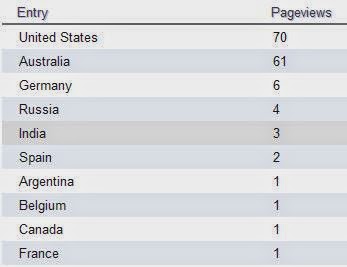
So we can be optimistic that we are adding to world wide knowledge!

Tuesday, May 27, 2014

May 2014

Despite the rather dry and warm weather in the middle of the month bird diversity was quite reasonable.  I ended up entering 81 species in the database, an increase of two species on those recorded in April 2014 (there is normally a slight decrease between those months) and three more than recorded in May 2013.
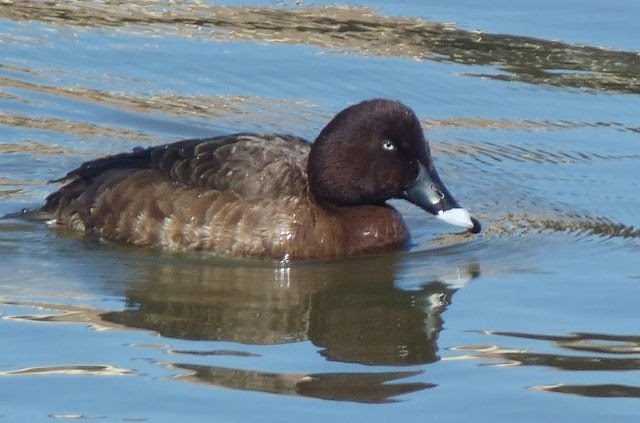
In terms of 'excitements' a Freckled Duck ...
.. was seen on a farm dam and photographed by Garry.  This was only our second record in the area: they seem to have disappeared from Canberra, but there are still a few around in Queanbeyan.  Also a second record for this project was a Restless Flycatcher seen on Wanna Wanna Road.  (This species looks somewhat like a Willie Wagtail but usually reveals itself by a loud churring call made as it hovers over tussocks seeking insects.)

A Musk Duck was also spotted (from the road) on Foxlow Lagoon.  This was the first seen since November 2013 - not 2011 as I said in the Gaxzette article!  That water is a hotspot for the species in the Canberra area.  It appears that they prefer dining on yabbies which become plentiful when water inundates a well vegetated area: this seems quite sensible with the water level n the lagoon rising recently after the dry of 2013.

Thanks to observers in Wanna-wanna and Widgiewa Roads,and the Hoskinstown Plain.   Please advise any interesting sightings to me at martinflab@gmail.com.


2 Birds of Prey:  Brown Goshawk;  Wedge-tailed Eagle;  Nankeen Kestrel

4 Kingfishers and other non-songbirds: Common Bronzewing; Crested Pigeon; Tawny Frogmouth; Laughing Kookaburra

5 Honeyeaters: Eastern Spinebill; Yellow-faced Honeyeater; White-eared Honeyeater; White‑plumed Honeyeater; Noisy Miner; Red Wattlebird; New Holland Honeyeater; Brown‑headed Honeyeater; White-naped Honeyeater

6 Flycatchers and similar species: Golden Whistler;Grey Shrike-thrush; Grey Fantail; WillieWagtail;Magpie-lark; Scarlet Robin;Red‑capped Robin, Flame Robin; Eastern Yellow Robin; Welcome Swallow; 

7 Thornbills, Finches and similar species:  Superb Fairy-wren; White-browed Scrubwren; Weebill; Striated Thornbill; Yellow‑rumped Thornbill; Buff‑rumped Thornbill; Brown Thornbill; Spotted Pardalote; Striated Pardalote; Silvereye; Double‑barred Finch; Red‑browed Finch; Diamond Firetail; House Sparrow

8 Other, smaller birds:  White-throated Treecreeper; Black-faced Cuckoo-shrike; Skylark; Common Blackbird; Common Starling; Mistletoebird; Australasian  Pipit;

9  Other, larger birds: Satin Bowerbird; Grey Butcherbird; Australian Magpie; Pied Currawong;Grey Currawong; Australian Raven; Little Raven; White-winged Chough

Tuesday, May 6, 2014

Some birds of Bungendore

This post is more about showing off some pleasant images than great news.

On 6 May I went for a patrol around Bungendore looking for water birds.  There was little water in some places and few birds in most places.

No Plumed Whistling Ducks were found anywhere.  I wonder where they have gone.  At the sewage works there were a couple of Shovelers and smallish numbers of Grey Teal and Eurasian Coots.

The big dam off lake Road had a small pool of water and a mud hollow but no birds.  So I turned around and about 200m up the road saw...
 ... an Egret.  The overall appearance made allocation to species quite easy but going for Cattle Egret was confirmed by the company it was keeping.
By the time I got back to Darmody's Dam a pair of Australian Shelduck had appeared.
 Note the white ring around the beak of the female.

In the background a reasonable number of Sulphur-crested Cockatoos were perched in a tree.  The question is how many?
My count was 54 in this tree and slightly more than that in two other trees and the nearby hay rack.  As about 40 had flown off as I arrived there could easly have been 150 in the area when I got there.  On occasion I have estimated over 500 each of this species and a similar number of Galahs present at one time.


Wednesday, April 30, 2014

April 2014

This months report could be titled "Where have all the birdies gone?".  As will be detailed below the month has been notable for the considerable decrease in diversity compared to the previous month (and to the month of April in previous years).  Possibly this has been due to the weather making the birds less likely to be observed - skulking in shelter rather than out and about.
It seemed worth exploring this a little bit so I have compared the species found in April for the last two years.  In summary:
The three species added in 2014 - Powerful Owl, Red-capped Robin and Yellow Thornbill - are all unusual for the area, although the Owl and the Robin have been regular this year.

Of the 18 species MIA this year:

  • 5 are waterbirds: possibly the widespread rains have caused them to head for other areas rather than the drought refuges in this area where we have observed the birds.  (Although out of area I have noticed a great reduction in the number and diversity of birds at Queanbeyan Sewage Works in the last 2 months.)
  • 4 species are diurnal raptors, suggesting that their prey species are in short supply.  This is probably good for those who don't like mice!
  • 3 species are nocturnal raptors which suggests that we were very lucky in 2013 rather than there being a problem in 2014.  This might also be related to a deficit in the rodent department.
  • Of the remaining 6 species, 4 are relatively unusual leaving two - Golden-headed Cisticola and Tree Martin - as surprising absences.

Thanks to observers in Wanna-wanna and Widgiewa Roads, Pony Place,and the Hoskinstown Plain.   Please advise any interesting sightings to me at martinflab@gmail.com.


2 Birds of Prey:   Wedge-tailed Eagle; Nankeen Kestrel; 

4 Kingfishers and other non-songbirds: Common Bronzewing; Crested Pigeon; Tawny Frogmouth; Powerful Owl;Laughing Kookaburra; 

5 Honeyeaters: Eastern Spinebill; Yellow-faced Honeyeater; White-eared Honeyeater; Noisy Miner; Red Wattlebird; New Holland Honeyeater; Brown‑headed Honeyeater; 

6 Flycatchers and similar species: Golden Whistler;Rufous Whistler; Grey Shrike-thrush;  Grey Fantail; WillieWagtail;  Magpie-lark; Scarlet Robin;Red‑capped Robin, Flame Robin; Eastern Yellow Robin; Welcome Swallow

7 Thornbills, Finches and similar species:  Superb Fairy-wren; White-browed Scrubwren; Weebill;  Striated Thornbill; Yellow Thornbill; Yellow‑rumped Thornbill; Buff‑rumped Thornbill; Brown Thornbill; Spotted Pardalote; Striated Pardalote; Silvereye; Double‑barred Finch; Red‑browed Finch; Diamond Firetail; House Sparrow; European Goldfinch

8 Other, smaller birds:  White-throated Treecreeper; Black-faced Cuckoo-shrike;  Dusky Woodswallow; Skylark; 
Common Blackbird; Common Starling; Mistletoebird; Australasian  Pipit;

9  Other, larger birds: Grey Butcherbird; Australian Magpie; Pied Currawong;Grey Currawong; Australian Raven; Little Raven; White-winged Chough

Wednesday, March 26, 2014

March 2014

Notes on birds March 2014

The most exciting sighting this month was a Red-kneed Dotterel  ...
..  on a farm dam on the Hoskinstown Plain.  This was an addition to the list for the project, which now stands at 185 species seen since February 2007.  Any anatomists amongst you should note that the red element of the leg is actually equivalent to the human ankle (note the way it bends).
As suggested in my previous column White-throated Needletail Swifts appeared on 15 March (but not bringing rain).  There have been a number of interesting ‘repeat offenders’.  Rufous Fantail turned up at Whiskers Creek;  a male Red-capped Robin turned up on Wanna-Wanna Rd and the Powerful Owl has continued to be heard in that area.  A Southern Boobook was observed in that area early one morning.

We scored about 5 species less than in March 2014 but only 1 less than for February 2013 but are well above the 5 year average for March.
Autumn migration is starting up with small (an un-small flock of about 100 birds - mainly Yellow-faced but including some White-naped - was reported on April 1 from the Plain ) flocks of Honeyeaters and Silvereyes moving through.
Most dam’s water levels have improved in the last few weeks (and it’s raining as I type) so hopefully waterbirds will return.  Please advise any interesting sightings to me at martinflab@gmail.com.


I have recently done a bit of updating of my links to photographs.  They now cover 85 of 185 species.  I will try to do a bit more updating in the near future, as I am sure I have images of some of the MIAs.


2 Birds of Prey:  Black-shouldered Kite;  Brown Goshawk; Wedge-tailed Eagle; Little Eagle; Nankeen Kestrel; Brown Falcon; Australian Hobby; Peregrine Falcon.

4 Kingfishers and other non-songbirds:  Stubble Quail; Common Bronzewing; Crested Pigeon; Tawny Frogmouth; White-throated Needletail; Southern Boobook;Powerful Owl; Laughing Kookaburra;

5 Honeyeaters: Eastern Spinebill; Yellow-faced Honeyeater; White-eared Honeyeater;  Noisy Miner; Red Wattlebird; New Holland Honeyeater; White-naped Honeyeater.

6 Flycatchers and similar species: Golden Whistler;Rufous Whistler; Grey Shrike-thrush; Rufous Fantail; Grey Fantail; WillieWagtail; Leaden Flycatcher; Magpie-lark; Scarlet Robin; Red‑capped Robin, Flame Robin; Eastern Yellow Robin; Welcome Swallow; Tree Martin

7 Thornbills, Finches and similar species:  Superb Fairy-wren; White-browed Scrubwren; Weebill; White-throated Gerygone; Striated Thornbill; Yellow Thornbill; Yellow‑rumped Thornbill; Buff‑rumped Thornbill; Brown Thornbill; Spotted Pardalote; Striated Pardalote; Silvereye;  Double‑barred Finch; Red‑browed Finch; Diamond Firetail; House Sparrow; European Goldfinch

8 Other, smaller birds:  White-throated Treecreeper;  Black-faced Cuckoo-shrike;  Dusky Woodswallow; Golden-headed Cisticola; Common Blackbird; Common Myna; Common Starling; Mistletoebird; Australasian  Pipit;

9  Other, larger birds:Grey Butcherbird; Australian Magpie; Pied Currawong; Grey Currawong; Australian Raven; Little Raven; White-winged Chough