Thursday, January 5, 2017

Annual Report 2016: Breeding birds

The preamble to this post is copied from last year.  That makes this report more self-contained, which I see as a Good Thing.  

It can be argued that recording breeding events is the most important aspect of bird observation since if the birds do not breed they will soon be extinct!  It is however a more difficult task than simple observation as: 
  • many birds go to some lengths to conceal their nests; and
  • it is necessary to be very cautious with most species to avoid frightening the birds away from the nest.
To ameliorate these problems some wide definitions of breeding is employed with the core events of "nest with eggs" and "nest with young" supported by a range of other, indirect, measures of breeding activity.  

In the case of the Canberra Ornithologists Group the traditional values ranging from breeding display to dependent young. (I sometimes feel that a new code is needed for "indolent young" when the Magpie chicks are clearly able to fend for themselves but would rather bludge off their parents.) To be rated as dependent young the fledglings 
  • must be out of the nest and generally be seen being fed by the parents or, 
  • in the case of waterbirds, be incapable of flight.   
I have made an exception for the Tawny Frogmouths where the fledglings are fed at night and it isn't possible to determine how this is achieved.  In that case the young are considered dependent until they move away from the parents some 10 weeks or so after leaving the nest.

In other countries such as Canada studies are undertaken which assume all birds seen or heard  during the breeding season are in fact breeding.  The International eBird project, run out of the prestigious Ornithology Programme at Cornell U in New York takes a very broad view with 22 codes including indirct codes such as “Singing male” (Possible breeding) and “Agitated Behaviour” (Probable breeding).  Of course, with this wide set it is possible to choose and I shall stick with the set of traditional codes used by COG for this project.  (As over 50% of COG General records are now sourced through eBird there must be some careful filtering done to map between the two systems.)


A difficulty with analysis of breeding records is that the peak breeding period in the Southern Hemisphere is split by the change of calendar year.  This is illustrated in the following chart (covering the first 9 years of the project - the 10th year won't change this picture so I have been lazy).
To overcome this I commenced, in mid 2009, recording the 'financial year" in which observations were made and it is possible from that point on to re-categorise observations to a "breeding year" (running from July to June).  

Since this project commenced 884 breeding records have been noted. The decision to use the COG Breeding codes was made in late 2009 and thus approximately 1/6th of the records are not coded to type of activity.  Such is life, and the uncoded records are excluded from the next chart!  

The percentage of records of each type is shown separately for the last complete 'season (2015-16) and the rest of the records in the chart below.
There is not a significantly different distribution of type of activity reported in 2015-16 and the rest of the series.  The preponderance of dependent young (code 'dy') records reflects both the relative ease of observing this and the duration of the phase - for some species this can go on for several months. It is recognised that the begging young could have been hatched out of the area.  (Of course ny does not necessarily mean the young survive to maintain the species: we have plenty of Pied Currawongs - and in my case this year a Collared Sparrowhawk - in the area to predate nests and fledglings.)
It might be noted that 87.5% of the records after December which have been coded to type of activity are dependent young. There have been several records of active pardalote, honeyeater and finch nests in the New Year.  In most cases these are presumably second broods, although the Yellow-faced Honeyeater nest in a floribunda rose on our deck is only active from late December.
The incidence of type of event x month is illustrated by this chart in which the redder fill indicates a greater number of records).  Some codes have been grouped to combine the less regularly reported ones.

Following from this, the next section mostly covers 6 breeding seasons ending on 30 June 2016. The 2016-17 season will, inshallah, be reported on next year, but at this stage appears similar to history.
Breeding season # breeding records
2010-11 124
2011-12 137
2012-13 105
2013-14 118
2014-15 98
2015-16 125
It is difficult to assign reasons for the differences shown in this table - I might try to do a separate post on this later, when feeling particularly masochistic.


Taking the number of species seen in each season the following result is obtained.    

Breeding season # breeding species
2010-11 50
2011-12 51
2012-13 49
2013-14 47
2014-15 41
2015-16 48
In past years my impression was that the number of breeding species is a little more stable that the number of breeding records.  However the very low number of breeding species in 2014-15 argues against that.  I can't at this stage offer an explanation for this, but will try to ponder the issue later.

The number of reports by species received over the 10 calendar years by species is summarised in the following table.
# reports
# species
1
18
2-4
30
5-10
20
11-19
17
20+
13
As expected a large proportion of species have only been reported undertaking breeding activity a few times.  The 13 species with 20 or more breeding records are:
  • Australian Magpie (66 reports): the swooping of defending adults and the whingeing of the dependent young are hard to ignore, however much one tries.  That being said no-one reported breeding behaviour by  Magpie in 2013-14 - I didn't even get swooped riding my bike!  The situation has returned to normal since!
  • Tawny Frogmouth (39 reports): Once noticed the nest and parents with dependent young are easy to relocate.  Also the breeding season is 5 months long from the start of nesting to kicking the young out.  
  • Pied Currawong (39 reports): see Australian Magpie.  In past years there was no way I could miss the {expletives deleted, with regret} pair that nested above our lawn and swoop me every time I walk across it!  For calendar 2016 they moved nest site by 30m and were much much more sociable
  • Striated Pardalote (39 reports): a serial offender at building a nest in any apparent hole in a building or tree.  Also very vocal when doing so!  This species re-entered the top list after dropping out in 2012-13
  • Willie Wagtail (32 reports): The records for this species cover a wide range of types of "nest-centred" events, possibly reflecting the energetic distraction displays, having the unintended outcome of leading keen observers to the nest (rather than away from it).  
  • Welcome Swallow (31 reports):  Similar to the previous species but prefers a more open site such as in the rafters of a shed.  
  • White-browed Scrubwren (25 reports)  A very active bird and repeated zooming into a bush with a mouthful of grubs attracts attention.
  • Australian Wood Duck (28 reports)  A very common bird around farm dams and lawns, in Spring often leading a conga line of ducklings from the nest in tree hollows.
  • Yellow-rumped Thornbill (22 reports): Very common species and feeding young often happens out in the open.
  • Australasian Grebe (27 reports) After being occupied as a nest site for several years our top dam has been deserted for the past 3 years. However I have received a few more reports from other observers so they have made the big league.  The young birds are particularly interesting with striped heads.
  • Grey Shrike-thrush (22 reports): this species often nests in sheds or on verandahs, so is easy to spot.  They also fit in more than one brood so get several reports per site-year.
  • Yellow-faced Honeyeater (21 reports): this species appears very relaxed about building close to dwellings - in our case in a rose bush next to our verandah clothes line..  So relatively easy to find and monitor the nest.
  • Red Wattlebird (20 reports): a large bird with very noisy fledglings.

Annual Report 2016: 2016 compared with 2015

I have indicated in the overview that the number of observers was restored in  2014.  

Of the  194 species recorded in this project 169 species (87.1% - a slight decrease on the percentages achieved y a similar analysis last year) were reported in one or both of the years covered by this report.  Of these 169 species:
  • ·         19 were reported in 2015 but not in 2016;
  • ·         13 were reported in 2016 but not in 2015 (of which 3 were reported for the first time in 2016); and 
  • ·         137 species were reported in both years.
Looking at the entire 168 species there is a very strong correlation (correlation coefficient =  0.90) between the number of months each species was reported in the two years.  Thus it can be concluded that the two data sets are reasonably consistent.

Of the 19 species recorded in 2015 but not 2016, 
  • 13 were sighted in a single month of 2015, 
  • 3 were seen in 2 months; 
  • 2 (Rufous Songlark and White-throated Needletail) in 3 months.  The Rufous Songlark was late arriving and infrequently seen across the COG region in 2016.  WRT Needletails the observer from the Widgiewa hotspot for this species has moved from the area. 
  • 1 (White-fronted Chat) in 4 months.   The Chats were only ever seen near Hoskinstown by observers looking at the Banded Lapwings:  perhaps there is some commonality of habitat preference by the two species?
For those seen in 2016 but not reported in 2015:
  • 9 species (3 additions to the area list) were seen in a single month;
  • 1 species (Whiskered Tern, only the second observation in the area) were seen in 2 months in 2014;  and
  • 3 species seen in 3 months;  
    • Brown quail tend to be seen irregularly in the area: they are skulkers so it isn't surprising that they go missing at times.
    • Silver Gull has been very unusual in the area.  However there has been a lot of water around this year so conditions have been right for more sightings than usual.
    • Spotted Quail-thrush is not common in the broader COG area, although Tallaganda (just outside the area for this project) is a hotspot.  Sightings this year have been around Wanna Wanna Rd, and the nearby Cuumbeun NR has some very typical habitat.
 43 species were reported every month in both years: a similar comparisons in recent years have shown 34 -38 species.  I am unsure what has caused the increase but see it as a Good Thing. I noted in the overview post that the set of species seen every month of the project has been very stable sitting at 19 species until this year when Willie Wagtail went walkabout for a year..

The following table shows the aggregate number of months in which members of the broad groups of species were seen in the two years.


Category 2015 2016
1 Waterbirds 231 203
2 Birds of Prey 66 67
3 Parrots and Relatives 94 100
4 Kingfishers and other non-songbirds 120 107
5 Honeyeaters 102 92
6 Flycatchers and similar species 132 125
7 Thornbills, Finches and similar species 192 189
8 Other, smaller birds 124 123
9 Other, larger birds 95 96
The similarity of results between the two years is readily apparent.  When expressed as a percentage of total species-months the correlation coefficient is 0.99.

There is no large increase in any group.


The group with the largest percentage decrease were Waterbirds.  As noted in the overview this group of birds declined dramatically across the SE of Australia from July onwards, as flooding in the West of NSW and Queensland recharged wetlands and farmland in those areas.  As the floods have receded the birds have begun to reappear in the South East.

The species with the largest increases in number of months-recorded have been:
  • Little Corella (+6, from 2 months to 8).  A flock of up to 30 birds has become regular, if not resident, around the junction of Widgiewa and Captains Flat Rds. Unquiet birds, they are hard to miss.
  • Common Myna (+4 from 6 months to 10).  Small flocks of rats with wings were reported from several locations between Hoskinsttown and Molonglo River Park.  Surprisingly they appear not to have settled down but keep moving.
  • Collared Sparrowhawk (+4  from 2 months to 6).  In the latter half of the year a pair have been around our house every day.  I am sure they are nesting somewhere  but have been unable to find the nest.
  • Pallid Cuckoo (+3 from 4 to 7).  This is more a matter of 2015 being low than 2016 being high. 
  • White-naped Honeyeater (+3 from 3 to 6).  The birds have seemed to be more frequently observed as members of migrating flocks (a mewing call rather than the chip of Yellow-faced Honeyeaters).
The species with the greatest decline were:

  • Hardhead (-8 months, from 12 to 4).  The earliest duck species to join the exodus and only just beginning to return in December.
  • New Holland Honeyeater (-5 months, from 11 to 6).  Almost entirely as a result of the departure of an observer from Widgiewa Rd who used to have a small resident flock.
  • Straw-necked Ibis (-5 months from 6 to 1)  Better pickings and breeding sites around the flooded areas..

Links to other sections of this report

Annual Report 2016: 2016 compared with 9 previous years

A starting point is the number of species reported in each month.


In the table-image above the year in which the highest number of species was observed for each month is highlighted in yellow.  Most of these months occur between September 2011 and May 2013 when observer activity was at peak levels and abundant rain fell, leading to an explosion of water birds on the Hoskinstown Plain. However we did establish new high marks in April and June 2016.

We were particularly short of observers (including this author) in the blue months, the row showing 2016 as a % of the average for the period since 2010 shows that we are still holding up.  Thank you to all observers who have contributed observations.

As reported in the overview we added 3 species to the list in 2015.  All three were waterbirds reported from a marsh on the Plain.  The breeding of one of these, Whiskered Tern, is the first such event recorded in the broader Monaro area since 1963.

Of the 150 species for which comparison is possible, 18 have been recorded in every month throughout the 9 years (obviously including every month of 2016) These are:

  • Australian Wood Duck; Galah; Sulphur-crested cockatoo; Crimson Rosella; Eastern Rosella; Laughing Kookaburra; White-eared Honeyeater; Noisy Miner; Magpie-lark; Welcome swallow; Yellow-rumped thornbill; White-throated treecreeper; Common starling; Grey butcherbird; Australian Magpie; Pied Currawong; Australian Raven; Little Raven.
A simple way of summarising the difference in reporting rate between 2015 and earlier years is by a tree diagram.


The number shown as 'same' is those where the % of available months (106 in total for earlier years, 2 months are missing) is within +/- 5%.   This allows for differential observer effort affecting the result by a small amount.
  
The pattern shown in this tree is somewhat different to that from 2015.  This "comparison of comparisons" is summarised in the following table.
The next table shows the number of increasers and decreasers by category of bird.  (I should point out that these categories are rather arbitrary, but just provide a few groupings that cover birds of broadly similar behaviours and/or habitats.)


Category Decrease Same Increase
1  Waterbirds 4 10 23
2 Birds of Prey 3 4 4
3 Parrots and Relatives 0 6 3
4 Kingfishers and other non-songbirds 6 12 5
5 Honeyeaters 2 7 2
6 Flycatchers and similar species 5 4 6
7 Thornbills, Finches and similar species 5 9 7
8 Other, smaller birds 2 5 9
9 Other, larger birds 0 7 1
Total  27 64 60


Many of the changes have been hinted at in earlier sections. 

The high number of 'increasers' in waterbirds was somewhat of a surprise in view of the exodus of such birds referred to in several parts if this Report.   In some cases it is an artefact of arithmetic, because 

  • a sighting a species in 1 month of 2012 (which infers the bird is unusual) is equivalent to 8.3% 
  • if it was only reported in one month for up to 4 of the preceding years (quite likely for an unusual bird) it would still meet the "rule" for increase whereas in fact it was the same.
Also I, at least, have been more aware in recent years which water features were likely to be productive (for example Musk Duck and Black Swan are nearly always observable when looking down on Foxlow Lagoon (but nowhere else).

The results for Parrots, Honeyeaters and Other larger birds all indicate a stable situation.


No group showed a noticeable drop.


Links to other sections of this report
Overview
Breeding Birds
2016 compared to 2015
2016 compared with 9 previous years.

Monday, January 2, 2017

December 2016

The starting image is of a Magpie-lark, photographed by Joy Williams, feeding its 4 chicks in a nest off Wanna Wanna Rd.
.Breeding is also a major aspect of the most exciting happening in the area (at least as far as birds go) in that Whiskered Terns are present on the Hoskinstown Plain in large numbers (at least 75 birds at times)  and are breeding.  On recent visits at least 30 nests have been observed in the sedges.
This is the first time these Terns have been recorded breeding in the area bounded (approximately) by  Goulburn, Yass and Cooma.  Very exciting!

On going to look at the Terns we have added 2 more species to the area list:
  • Baillons Crake

  • Sharp-tailed Sandpiper

To complete the coverage of exciting and unusual birds a Channel-billed Cuckoo (was heard from our place, and by a neighbour who recognised the very distinctive call from her time living in Brisbane.

Overall the diversity has been rather good this month after a little bit down recently.  At 111 species we are slightly above average for the month.

Migration has pretty much finished with two Cuckoos (Brush and Channel-billed) being the last arrivals.  Most species arrived in the expected months - a contrast to last year when many species were early.  A few species have not been observed this year with Rufous Songlarks being the most unlikely omission.  Possibly this reflects very good conditions for them "out West" combined with the very wet and cool Spring.

Breeding has really been happening all over.  20 species have been observed contributing in one or more ways to the continuation of their species.  They are shown with red text in the list below.

As always, thanks to the observers who have provided reports to me for the month.  These have covered sites in Whiskers Creek Rd, Widgiewa Rd, Knox Close, Radcliffe Circuit, Douglas Close, Captains Flat Rd, Wanna Wanna, and Hoskinstown Village and  Plain.. I'm always happy to receive reports, my email address is martinflab@gmail.com.

I shall endeavour to do my Annual Bird Report for 2016 in the next few days and will circulate links via the discussion group and Facebook page as appropriate.


1  Waterbirds (pt 1):  (pt 2)(Pt 3); (Pt 4): Musk Duck; Black Swan;  Australian Shelduck; Australian Wood Duck;  Australian Shoveler; Grey Teal; Chestnut Teal; Pacific Black Duck; Hardhead; Australasian Grebe; Hoary-headed Grebe; Little Pied Cormorant; White‑necked Heron;  White‑faced Heron; Australian White Ibis; Purple Swamphen; Baillons Crake Dusky Moorhen;  Eurasian  Coot; Black-winged Stilt;  Masked Lapwing; Latham’s Snipe; Sharp-tailed Sandpiper; Whiskered tern; Silver Gull

2 Birds of Prey:  Brown Goshawk; Collared Sparrowhawk; Spotted Harrier; Wedge-tailed Eagle; Little Eagle; Nankeen Kestrel;

3 Parrots and Relatives:  Yellow-tailed Black-Cockatoo; Gang‑gang Cockatoo; Galah;  Little   Corella; Sulphur‑crested Cockatoo; Australian King‑parrot; Crimson Rosella; Eastern Rosella; Red-rumped Parrot

4 Kingfishers and other non-songbirds (Pt 1) (Pt 2) (Pt 3): Stubble Quail; Common Bronzewing; Crested Pigeon; Tawny Frogmouth; Australian Owlet-nightjar; Painted Button-quail; Channel-billed Cuckoo; Shining Bronze‑cuckoo; Pallid Cuckoo; Fan‑tailed Cuckoo; Brush Cuckoo; Southern Boobook; Laughing Kookaburra; Sacred Kingfisher

5 Honeyeaters: Eastern Spinebill; Yellow-faced Honeyeater; White-eared Honeyeater; Noisy Miner; Red Wattlebird; New Holland Honeyeater;  Brown‑headed Honeyeater; Noisy Friarbird;

6 Flycatchers and similar speciesRufous Whistler; Grey Shrike-thrush;  Grey Fantail; Willie Wagtail; Leaden Flycatcher;  Magpie-lark; Scarlet Robin; Eastern Yellow Robin; Welcome Swallow; Fairy MartinTree Martin

7 Thornbills, Finches and similar species (Pt 1) (Pt 2):  Superb Fairy-wren; White-browed Scrubwren; Weebill;  White-throated Gerygone; Striated Thornbill; Yellow‑rumped Thornbill; Buff‑rumped Thornbill; Brown Thornbill; Spotted Pardalote; Striated Pardalote; Silvereye; Red‑browed Finch; House Sparrow; European Goldfinch

8 Other, smaller birds:  White-throated Treecreeper; Spotted  Quail-thrush; Black-faced Cuckoo-shrike; White‑-winged Triller; Olive‑backed Oriole; Dusky Woodswallow; Skylark; Golden-headed Cisticola; Australian Reed-warbler;  Brown Songlark; Common Blackbird; Common Myna; Common Starling; Mistletoebird; Australasian  Pipit;

9  Other, larger birds: Satin Bowerbird; Grey Butcherbird; Australian Magpie; Pied Currawong; Grey Currawong; Australian Raven; Little Raven; White-winged Chough

Saturday, December 10, 2016

Whiskered Terns in Carwoola pt 2

Following the initial sighting of Whiskered Terns on the Hoskinstown Plain they appeared to be starting to breed there on 9 December.  Birds were seen carrying vegetation and landing in the reeds in the middle of a Marsh.

Garry and I visited the marsh on the 10th of December and counted at least 40 birds and at least 10 pairs sitting on or near nests.


As far as my research thus far reveals this is the first record of the species breeding in the COG Area of Interest (roughly a rectangle with extrema at Goulburn and Adaminaby) since November 1963.

The pasture around the marsh is, to say the least luxuriant, as shown by the way Herefords only just poke out.
We walked along the edge of the marsh, trying not to think about Tiger Snakes.  Some people get Cleopatra, others get the Asp!
 This gives an idea of the habitat the birds were nesting in.

Wednesday, November 23, 2016

November 2016

The above cartoon was originally published in Punch in November 1895.  It is pretty much a fair comment on birding in Carwoola 121 years later!

To deal with the less good bits first, this chart shows overall diversity was significantly lower than other recent Novembers.
We fell short in Waterbirds and Raptors with most of the MIAs in other categories being less common birds in this area.

Getting on to the better bits, despite the comment above the more unusual birds were all waterbirds.  I presume this means the change of seasons has led to the waterbirds moving around somewhat with many of those that left the area to seek the floods in Winter still being away and other species turning up.  

The star of the month, from a marsh on the Hoskinstown Plain, was the first record in this area of a Red-necked Avocet, featured below hiding behind an Australian Shelduck.  (I had not previously realised the similarity in colour of the head of the Avocet and the breast of the Shelduck.)
Other unusual sightings for this area, also from the marsh, were the second sighting of Whiskered Terns (8 birds)


 and the fourth of a Silver Gull.  Later in the month I received 2 sightings of Latham's Snipe at other sites on the Plain.

Breeding is still happening with 14 species being recorded in various stages of the process.  " Our" Frogmouths have successfully fledged 2 chicks after a drawn out process.  They have then vanished. A particularly interesting report is of a pair of Sacred Kingfishers occupying a tree-hollow in Knox Place: hopefully they'll complete the process.  The species are marked in red in the list below.

Migration has pretty much finished.  I had initially noted White-winged Triller (which seems to turn up some years and not others) as absent this year but have since got a report of them from Capatans Flat Rd.  Still missing is Rufous Songlark (COG has noted that they seem to have found enough habitat in the West to not need to come this way in 2016).  Neither of the big cuckoos (Channel-billed Cuckoo and Eastern Koel) have definitely turned up here yet, but are in Canberra.

As always, thanks to the observers who have provided reports to me for the month.  These have covered sites in Molonglo River Drive, Whiskers Creek Rd, Widgiewa Rd, Knox Close, Radcliffe Circuit, Douglas Close, Captains Flat Rd, Wanna Wanna, and Hoskinstown Plain.. I'm always happy to receive reports, my email address is martinflab@gmail.com.

Readers might like to also see this post from our block - noting that it shows a Sparrowhawk feeding in a rather sanguinary fashion.

1  Waterbirds (pt 1):  (pt 2)(Pt 3); (Pt 4): Black Swan;  Australian Shelduck; Australian Wood Duck;  Australian Shoveler; Grey Teal; Chestnut Teal; Pacific Black Duck; Australasian Grebe; Hoary-headed Grebe; Little Black Cormorant; Little Pied Cormorant; White‑faced Heron; Australian White Ibis; Eurasian Coot; Masked Lapwing; Latham’s Snipe;  Whiskered tern, Silver Gull

2 Birds of Prey:  Collared Sparrowhawk;Wedge-tailed Eagle; Nankeen Kestrel; 

3 Parrots and Relatives: Yellow-tailed Black-Cockatoo; Gang‑gang Cockatoo; Galah;  Little Corella; Sulphur‑crested Cockatoo; Crimson Rosella; Eastern Rosella; Red-rumped Parrot

4 Kingfishers and other non-songbirds (Pt 1) (Pt 2) (Pt 3): Stubble Quail; ; Common Bronzewing; Crested Pigeon; Tawny Frogmouth; Horsfield's Bronze‑Cuckoo; Shining Bronze‑cuckoo; Pallid Cuckoo; Fan‑tailed Cuckoo;  Laughing Kookaburra; Sacred Kingfisher

5 Honeyeaters: Eastern Spinebill; Yellow-faced Honeyeater; White-eared Honeyeater; Noisy Miner; Red Wattlebird; White-naped Honeyeater; Noisy Friarbird

6 Flycatchers and similar species:;Rufous Whistler; Grey Shrike-thrush; ; Grey Fantail; Willie Wagtail; Leaden Flycatcher;  Magpie-lark;Scarlet Robin; Eastern Yellow Robin; Welcome Swallow; Fairy Martin; Tree Martin

7 Thornbills, Finches and similar species (Pt 1) (Pt 2):  Superb Fairy-wren; White-browed Scrubwren;  Weebill; White-throated Gerygone; Striated Thornbill; Yellow‑rumped Thornbill; Buff‑rumped Thornbill; Brown Thornbill; Spotted Pardalote; Striated Pardalote; Silvereye; Double‑barred Finch; Red‑browed Finch; House Sparrow; European Goldfinch

8 Other, smaller birds:  White-throated Treecreeper; Black-faced Cuckoo-shrike; Olive‑backed Oriole; Dusky Woodswallow; Skylark; Golden-headed Cisticola; Australian Reed-warbler; Brown Songlark; Common Blackbird; Common Myna; Common Starling; Australasian  Pipit;

9  Other, larger birds: Satin Bowerbird; Grey Butcherbird; Australian Magpie; Pied Currawong; Grey Currawong; Australian Raven; Little Raven; White-winged Chough

Sunday, November 13, 2016

Whiskered Terns in Carwoola pt 1

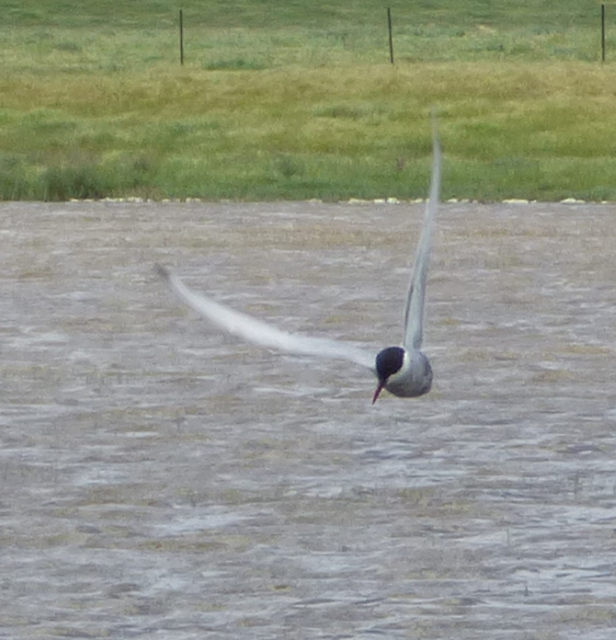
Today (13 November) I got a phone call saying that some terns were flying around the swamp in the Plain.  By the time I had got down there they'd been identified as Whiskered Terns and 8 were counted.  One of them came close several times allowing me to get some photos.  (As it was blowing a gale, and the birds fly quite quickly, the photographic process was "Point the camera in the general direction and press the button."  Seems to have worked OK).


 Sometimes there were up to 3 fairly close.  Here's a "poetry in motion" or Monetesque snap of a vol de deux.